Article
Auto parts manufacturer's guide to single-source publishing

Summary:
Auto parts manufacturers routinely maintain the same warnings, specs, and procedures across dozens of product manuals - each one a separate file, each one requiring a manual update whenever anything changes. Single-source publishing solves this by storing content once as reusable components and assembling manuals automatically. A global consumer products manufacturer using Author-it achieved 60-70% content reuse, cutting the effort behind every product update by more than half.
The hidden scale of your duplication problem
Picture a standard high-voltage warning. It appears in your brake system manual, your suspension guide, your installation procedures, your training pack - across every language you publish. That's not one piece of content. That's forty pieces of content that happen to say the same thing.
Every time regulations change, a product spec shifts, or legal updates the language on that warning, someone opens forty different files and makes forty identical edits. Most of the time, they get thirty-nine of them. The one they missed is the one in the field.
This is the version drift problem. It's not dramatic until it is. A wrong torque spec in a field service manual. An outdated safety procedure in a training module. These aren't typos - they're the direct result of a documentation architecture that wasn't designed for scale.
What single-source publishing actually means
Single-source publishing means writing content once - as a component - and assembling it into every deliverable that needs it. The warning lives in one place. The spec lives in one place. The procedure lives in one place. Each manual is an assembly of those components, not a copy of them.
When you update the source component, every manual that uses it reflects the change automatically. You don't find the files. You don't open twelve InDesign documents. You edit one topic, approve it, publish - and the downstream content updates.
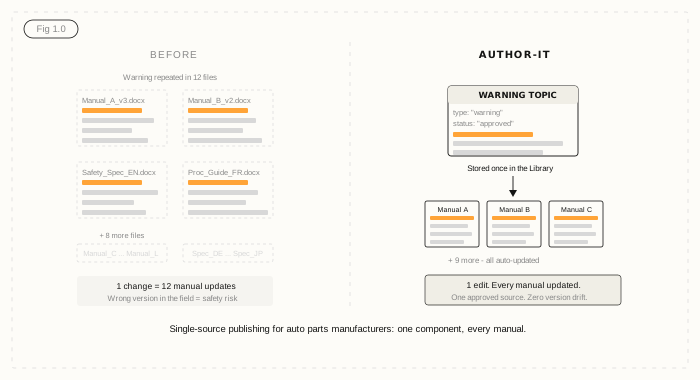
In a Component Content Management System (CCMS), content components are called Topics. They're typed - a warning Topic is structured differently from a spec Topic or a procedure Topic. That structure is what makes automated assembly possible: the system knows what goes where.
Why version drift is a safety issue, not just an efficiency one
In most industries, having slightly stale documentation is an embarrassment. In auto parts manufacturing, it can be a liability.
Your field service team relies on the procedures in their manual being current. Your compliance team relies on your safety data sheets matching approved specifications. Your distributors rely on the installation guides reflecting the latest product revision.
When those documents are maintained as separate files - each updated manually, each potentially out of step - you're one missed update away from a field incident or a compliance failure. The risks of SOP sprawl in manufacturing are well-documented, and product documentation has the same failure mode: distributed updates, inconsistent versions, no single source of truth.
Single-source publishing removes that risk architecturally. The component either has the current content or it doesn't. If it does, every manual using it does too. There's no version to miss.
What reuse looks like at scale
A global consumer products manufacturer using Author-it achieved 60-70% content reuse across their documentation library. That figure means that for every 10 pages of content they publish, six or seven pages already exist as approved, reusable components. Writers spend time on genuinely new content - product changes, new variants, new markets - not recreating what's already been written.
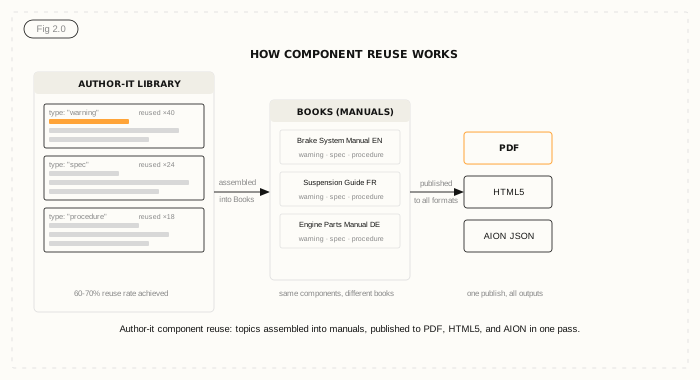
At that reuse rate, a product update that once required opening twelve separate files and editing each one now means updating a handful of components. The manuals - all of them - assemble themselves from the updated source.
Translation costs follow the same logic. If a component hasn't changed, you don't pay to translate it again. Manufacturers with high content reuse have cut translation spend significantly - because you're only ever paying for what's genuinely new.
If you want to understand the potential value of that for your team, the Author-it ROI calculator lets you model the numbers against your actual documentation volume.
The AI angle: structured content as your foundation
There's a second reason to get your content architecture right now, beyond the manual update problem.
Manufacturing AI initiatives - field service assistants, compliance Q&A tools, parts lookup agents - all depend on being able to query your documentation and return accurate, verified answers. That only works if the source content is structured, versioned, and governed.
Unstructured PDFs and disconnected Word documents fed into an AI system produce unstructured answers. You can't trace where the answer came from. You can't verify that it reflects your current approved specification.
Author-it's AION output delivers your content as structured JSON - with component metadata, version information, and authorship - purpose-built for LLM ingestion and RAG pipelines. The same single-source architecture that eliminates your manual update problem also becomes the AI content foundation your manufacturing AI initiatives need to function accurately.
Structured content isn't just better documentation. It's the infrastructure layer that makes enterprise AI trustworthy.
Getting started: where to look first
If your team is managing product documentation across multiple files, here's what typically reveals the scale of the problem fastest:
- Pick one frequently-used component - a standard warning, a torque spec, a regulatory statement - and count how many documents contain a version of it
- Check when each version was last updated - they won't all match
- Estimate how long your last product update took to flow through every affected manual
That exercise usually answers the question of whether single-source publishing is worth exploring. Most documentation teams find the number is larger than they expected.
The Author-it manufacturing page covers how other manufacturers have approached this, and the Structured Content Challenge is a fast way to benchmark where your current setup stands.

Single-source publishing FAQ
Q: What is single-source publishing for auto parts manufacturers?
A: Single-source publishing means storing each piece of content - a warning, a spec, a procedure - once as a reusable component, then assembling it automatically into every manual, guide, or compliance document that needs it. When the component changes, every document using it updates automatically. Auto parts manufacturers use this to eliminate the problem of maintaining identical content across dozens of separate files.
Q: How can auto parts manufacturers stop maintaining the same content in multiple files?
A: By switching from document-based authoring to component-based authoring in a CCMS. Instead of writing a warning or spec into each document separately, you write it once as a Topic, store it in a central Library, and assemble your manuals from those components. A change to the source Topic flows to every manual automatically - no file-hunting, no manual edits across twelve documents.
Q: What is content reuse and why does it matter for manufacturers?
A: Content reuse is the practice of using the same content component across multiple documents without copying or recreating it. For manufacturers, high reuse rates - typically 60-70% in mature implementations - mean that most of the content in any new manual already exists in approved form. Writers focus on genuinely new content rather than rewriting what already exists. Translation costs also fall because unchanged components don't need to be translated again.
Q: What is a CCMS and how does it work for technical documentation management?
A: A Component Content Management System (CCMS) manages content at the component level rather than the document level. Instead of storing whole Word or InDesign files, a CCMS stores individual Topics - procedures, warnings, specs, concepts - in a central Library. These Topics are assembled into Books (manuals, guides, training packs) and published to multiple formats from one source. Author-it is an enterprise CCMS with 25+ years of deployment in manufacturing and other regulated industries.
Q: What happens to auto parts manuals when a product spec changes in a single-source system?
A: In a single-source system, you update the relevant component - the spec Topic - once. Every manual that references that component automatically reflects the change when next published. There's no list of files to track down, no risk of missing one. The update flows everywhere the component is used, consistently and completely.
Q: How does single-source publishing reduce translation costs for auto parts manufacturers?
A: Translation in a single-source system is component-level, not document-level. Only content that has genuinely changed since the last translation gets sent out. If a warning has been approved and translated before, and nothing has changed, it doesn't go to translation again. Manufacturers with high content reuse have reduced translation overhead significantly - in some cases by up to 90% - because they're only paying for new or changed content.
Q: Is single-source publishing only useful for large manufacturers with hundreds of manuals?
A: No - though the ROI is highest at volume, the version control benefit applies at any scale. If you maintain the same content in more than a handful of documents and update any of it regularly, version drift is already a risk. The question isn't whether your documentation volume is large enough to justify it; it's whether the cost of a missed update - a wrong spec in the field, a failed compliance audit - is acceptable.
Q: How does structured content support AI initiatives in manufacturing?
A: Field service AI, compliance Q&A tools, and parts lookup agents all need accurate, verifiable answers drawn from your own documentation. That requires source content that is structured, versioned, and approved - not unstructured PDFs or disconnected Word files. Author-it's AION output delivers your content as structured JSON with full component metadata, designed for direct ingestion into LLMs and RAG pipelines. The same architecture that eliminates manual update problems also makes your documentation AI-ready.
Published on:
Author:
May 31, 2026
Jamie Simmonds
Documentation Manager
Related Resources

Article
The real cost of DITA - and when you don't need it
The cost of DITA is mostly staffing and process. Here is where it hides - and how to get topic reuse and single-source publishing without XML.
Article
AI content delivery: own your output, not a hub
The difference between renting an AI delivery hub and owning your content as open, portable JSON that feeds any AI stack you build or buy.
Article
Why equipment documentation breaks as you scale
As equipment makers add product lines, manual updates pile up faster than the products ship - the fix is managing content as components, not files.