Article
Author-it launches AION: AI content foundation

Why it matters:
Enterprise AI is only as good as the content feeding it. AION gives every RAG pipeline structured, governed, metadata-rich content by design.
Summary:
Author-it's relational database architecture has always stored content the way AI needs it - structured, governed, and metadata-rich at the component level. AION is the JSON publishing format that exposes what the database has always contained. It ships as a standard output in every Author-it deployment, at no extra cost, and required zero architectural changes to build. No other CCMS in the market was built this way from the ground up.
See the bigger picture on the AI content foundation page, or go straight to how AION works.
The AI content problem nobody is talking about honestly
Every enterprise AI deployment hits the same wall. Not the model. The content.
Organisations feed their documentation to an LLM or RAG system and discover the content they assumed was a structured knowledge base is actually a collection of PDFs, SharePoint folders, and Word documents - no metadata, no provenance, no version control, no governance. The AI retrieves what sounds relevant, not what is correct. It presents answers with equal confidence regardless of whether the underlying content is approved, current, or applicable. The result is hallucinations that look authoritative and are difficult to trace.
The market's answer to this has been overlay tools: inference engines, ontology platforms, semantic layers bolted onto content that was never designed to carry any of it. These tools do useful work. But they are solving for the absence of something that should have been there from the start.
Author-it never had this problem. And AION is how that fact becomes visible.
Why building AION required zero architectural changes
Author-it is built on a relational database. Every content component - every topic, every warning, every procedure - has existed as a discrete, governed object with a persistent identifier, a modification history, a release state, a template type, and a set of relationship records since day one. That is not a feature. That is the foundation.
When the product team built AION, there was nothing to rearchitect. The structured content, the component-level metadata, the content hierarchy - it was already in the database. AION is a publishing pipeline that exposes what Author-it has always contained.
Competitors built on document-oriented or file-based architectures face a genuine structural limitation. The intelligence they need to expose to AI systems was never captured at authoring time. Overlay tools can infer relationships from existing documents. They cannot manufacture governance, provenance, or component-level metadata that was never stored.
Author-it's content is already structured, governed, and relationship-rich. The job of AION is publishing what the database already knows in a format that AI can reason from.
No other CCMS in the market was built this way from the ground up. That is an architectural fact with 25 years of track record behind it.
What AION publishes today
AION exports a structured JSON representation of published content designed for direct ingestion by LLMs, RAG pipelines, vector databases, and enterprise AI agents. Every AION output includes:
- Full content hierarchy - the complete book and topic structure, preserving the logical organisation of content at component level
- Resolved variable values - product names, model numbers, version identifiers, substituted at publish time for precise, unambiguous content
- Author identity and modification metadata - who last modified each component and when, at the component level, not the document level
- Template type assignment - the semantic classification of every content object. An AI receiving AION output knows whether a component is a warning, a procedure, a specification, or a product description
- Unique persistent object IDs - every component carries its identifier across its entire lifecycle regardless of location or rename
- Folder path and library provenance - where in the content architecture each component lives
- Publishing job metadata - the job details and parameters that produced the output, enabling traceability from AI answer back to publishing event
- Complete content text - including embedded content, alternate text, and component descriptions
AION output is delivered via HTTP Post to any downstream system: a vector database, a RAG pipeline ingestion endpoint, an enterprise AI platform, or a custom integration.
AION is available to all Author-it Cloud customers as of the 2026.R1 release. It is included in every Author-it subscription at no additional cost - no add-on module, no premium tier.
Why this makes enterprise RAG work better
The dominant architecture for enterprise AI deployment right now is Retrieval Augmented Generation (RAG) - where an AI system retrieves relevant content at query time and generates answers grounded in that content. The quality of every answer is almost entirely determined by the quality of what it retrieves.
Metadata-rich content produces materially better results across the entire pipeline:
- Better embeddings. A content component carrying its type, product applicability, and authorship metadata produces a more precise vector representation than the same text stripped of context.
- Better retrieval. The AI can filter by content type and modification date before similarity search runs - finding the right content, not just the most textually similar content.
- More trustworthy answers. Every AI answer can be traced to a specific component, its author, and when it was last verified. In regulated industries, that provenance is not optional.
The efficiency argument is real too. Every token an LLM processes costs money. When the AI receives content type, governance state, and product applicability explicitly in metadata, it does not need to infer them from surrounding text. Shorter, more precise context windows reduce the cost and latency of every query.
The industries where this matters most
AION's value is proportional to the cost of getting a content-driven AI answer wrong. In regulated industries, that cost is high.
In manufacturing, a field service AI assistant needs to cite current, approved procedures - not a superseded revision that sounds identical to a keyword search. Single-source authoring means that when a component specification changes, every procedure referencing it reflects the change at the next publish.
In software and technology, the challenge is version fragmentation: the right answer for version 3.2 is the wrong answer for version 4.0. AION's variable resolution and template classification give AI systems the granularity to differentiate answers by product version without requiring duplicate content.
In utilities, organisations running AI against operational and compliance documentation need audit trail fidelity. When an AI-assisted field decision draws on a specific procedure, the organisation must be able to produce the exact content retrieved, its approval history, and who approved it. AION's provenance metadata - combined with Author-it's component-level version history - provides this by design.
AION ships in every Author-it Cloud subscription as of 2026.R1, at no extra cost. Explore AION or book a demo to see it run on your own content.
We built Author-it on a relational database because structured, governed content was always the right way to manage content at enterprise scale. We did not build it for AI - AI didn't exist when we started. But the architecture we chose turns out to be exactly what reliable enterprise AI requires: component-level metadata, governed provenance, semantic structure at authoring time. When our team built AION, there was nothing to rearchitect. The content intelligence was already in the database - it always has been. We just built a publishing format that exposes it. Every other vendor in this space is retrofitting. We are not, which isn't just another claim - it's a consequence of 25 years of building the right way.

Adrian Winks, CEO, Author-it

Featured in the news:
AION FAQ
Q: What is AION?
A: AION is Author-it's AI-native structured JSON publishing format, available to all Author-it Cloud customers as of the 2026.R1 release. It exports complete content hierarchy, resolved variable values, component-level metadata, release state, template type classification, and unique persistent object identifiers in a structured JSON schema designed for direct ingestion by LLMs, RAG pipelines, vector databases, and enterprise AI agents.
Q: Does AION cost extra?
A: No. AION is included in every Author-it subscription at no additional cost. It is a standard publishing format - no add-on module, no premium tier required.
Q: Why did building AION require no architectural changes to Author-it?
A: Author-it is built on a relational database in which every content component has always existed as a discrete, governed object with a persistent identifier, modification history, release state, and template classification. AION is a publishing pipeline that exposes what the database has always contained. The structured, metadata-rich content intelligence was already there - no rearchitecting was needed.
Q: What metadata does AION publish?
A: AION publishes full content hierarchy, resolved variable values, author identity and modification timestamps at the component level, template type classification, unique persistent object IDs, release state, folder path and library provenance, publishing job metadata, and complete content text including embedded content and alternate text.
Q: How does AION improve RAG pipeline performance?
A: AION-sourced content improves RAG pipelines in three ways: better embeddings (metadata-rich chunks produce more precise vector representations), better retrieval (content can be filtered by release state, content type, and modification date before similarity search runs), and more trustworthy answers (every AI-generated answer can be traced to a specific component with its author, approval state, and last-verified date).
Q: Which industries benefit most from AION?
A: AION is particularly valuable in regulated industries where content accuracy carries compliance and safety obligations: manufacturing, software and technology, and utilities. In these industries, the provenance and governance metadata AION provides - release state enforcement, component-level author identity, single-source change propagation - is what distinguishes a defensible AI deployment from a liability.
Q: How does AION connect to downstream AI systems?
A: AION output is delivered via HTTP Post to any configured endpoint - a vector database, an enterprise AI platform, a custom RAG ingestion pipeline, or any system that accepts JSON. No custom integration work is required to start publishing structured, AI-ready content.
Q: Can AI systems be configured to draw only from approved content?
A: Yes. AION includes Release State metadata on every content component - Draft, In Review, Approved, or Published. AI pipelines can be configured to filter on this metadata, ensuring the AI draws only from content that has passed Author-it's governance workflows. Unapproved content cannot reach published output by design.
Published on:
Author:
April 3, 2026
Adrian Winks
CEO
Related Resources

Article
The CCMS reckoning: six priorities for the AI era
A response to the industry's CCMS reckoning: the six priorities content leaders now face, and an honest look at which are shipped versus roadmap.
Article
AI-ready content: who has actually shipped it?
A practical field guide to separating AI-ready content marketing from vendors who have actually shipped a structured, governed output for AI.
Webinar
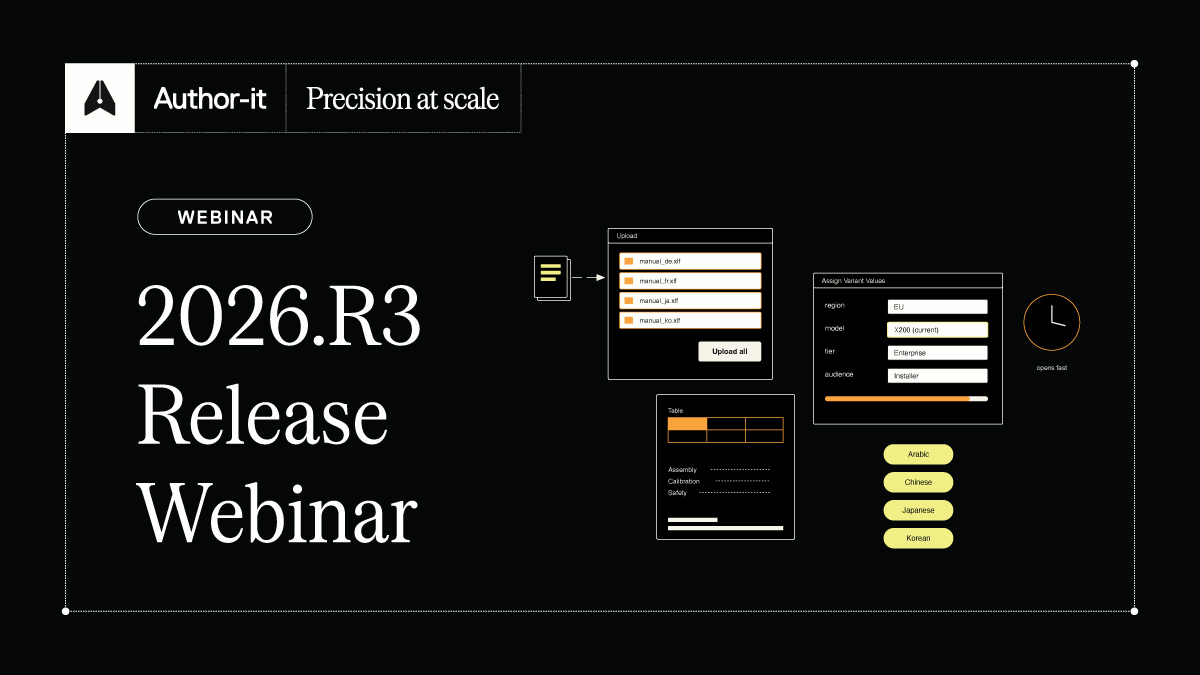
Author-it 2026.R3 Release Webinar - What's New
The full Author-it 2026.R3 release webinar recording, with the biggest New Word update yet, richer AION output, and the R3 go-live dates.