Article
Multi-Region Product Documentation: Why Your Setup Won't Scale

Why it matters:
Every new region you add multiplies your documentation update burden - until one missed update becomes a compliance or safety problem.
Summary:
Multi-region product documentation management breaks gradually - not all at once. Each new market adds a copied document, a new translator relationship, and a new version that drifts from the source. By the time a manufacturer realises their setup can't scale, they're already maintaining 8 versions of the same manual with no reliable way to keep them in sync. The fix isn't better file management - it's a different architecture: single-source, component-based content with regional variants built in from the start.
How multi-region documentation breaks
Most manufacturers don't set out to build a documentation mess. It starts reasonably: one solid manual, translated into the markets you serve. Then you launch in a new region. You copy the existing manual and hand it to a local team or translation agency. Then another region. Then a product update that needs to go into all of them.
Nobody decides to create chaos. It accumulates, one market at a time.
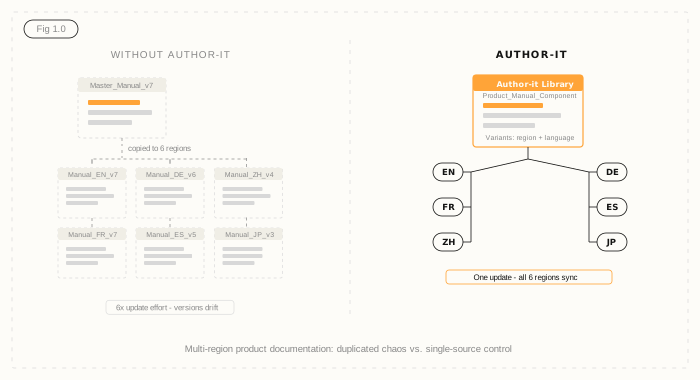
The four failure modes
There are four predictable ways multi-region product documentation management breaks down - and most manufacturers are already living with at least two of them.
The duplication spiral is the first. A product change - a new safety warning, an updated torque specification, a revised installation step - needs to go into every regional version. If you have six languages, that's six separate files to open, find, update, review, and approve. Miss one, and you have a regional manual with outdated safety information. At scale, with dozens of product lines and hundreds of documents, manual consistency is effectively impossible.
The translation chaos follows. Without a translation management system, you send whole documents to agencies and pay to re-translate content that hasn't changed. A section that's been identical across five product updates still goes for translation every time, because there's no mechanism to identify what's new. Translation costs for technical documentation can run to six figures annually for manufacturers with global reach - and a significant portion is pure waste.
The regulatory variant trap is subtler. Region A requires different safety language than Region B. You handle this by creating variant documents manually - one for EU compliance, one for North American standards, one for the Asia-Pacific market. The problem emerges when a specification changes. You update the base document but forget one of the variants. Or the person who knows which regulatory rules apply to which region leaves the company. Now you have compliance risk baked into your documentation workflow.
Finally: the ownership problem. As documentation scales across regions, accountability becomes unclear. The German team maintains their version. The North American team maintains theirs. There's no central governance, no approval workflow that spans all versions, and no single person who can tell you with confidence which regional manual is current. When a regulator asks for proof that all field manuals reflect the latest specification - you're finding out the hard way.
What good looks like
The manufacturers who've solved this aren't doing better file management. They've changed the underlying architecture.
The principle is single-source publishing: you maintain one content component, not six copies of a document. Regional variants - different regulatory language, different market-specific warnings, different formatting requirements - are built into the component as conditional content. When you publish, the system generates the EN, DE, FR, ES, ZH, and JP outputs from that single source. Change a specification in one place. It flows to every output automatically.
This is how Author-it's Variants work in practice. A product manual component holds the core content once. Conditional logic handles the regional differences - different safety certifications for different markets, local regulatory language, market-specific product names. You don't maintain eight documents. You maintain one, with variations.
Translation at the component level changes the economics completely. Only new or changed components go to the translation agency. If the installation procedure hasn't changed between versions, you don't pay to translate it again. Manufacturers using this approach typically cut translation spend by 30-50% in the first year. The manufacturing documentation case study shows one global consumer products company reducing translation costs by up to 90% through component-level reuse.
Central governance means one library, one approval workflow, one source of truth. When a product specification changes, the update goes into the library component and goes through the Review and Approve workflow once. Every regional output reflects it. There's no question about which version is current - because there's only one version, expressed in multiple outputs.
The cost of waiting
The common objection is that migration is too painful. The current setup works well enough. You'll deal with it when it becomes a real problem.
The challenge with that reasoning: by the time it feels like a real problem, you're already past the point where a quick fix works. You have years of version drift across regional files. You have no audit trail showing which changes were approved and when. You have translation memories scattered across different agencies with no central TM. Unpicking that takes longer than starting structured early.
There's also a quieter cost. Every product update that requires manual propagation across 8 regional documents is an hour or more of documentation team time - per product line, per update cycle. Run the numbers: a manufacturer with 20 product lines, updating documentation quarterly, with 6 regional versions each, is looking at hundreds of hours of copy-propagation work per year. That's before translation costs, before compliance reviews, before the time spent reconciling versions after a missed update.
Building the foundation for multi-region scale
If you're at the point where regional documentation is clearly becoming a burden, the question isn't whether to change the architecture - it's where to start.
The practical entry point is an audit of your current documentation set. How many documents do you have? How many are regional variants of core content? How much of that content is actually unique to a region versus a copy of shared content? In most cases, 60-80% of the content is shared - and that shared content is what you consolidate first.
From there, a structured authoring approach means building that shared content as reusable components, with regional variants handled as conditional output rather than separate files. The single-source publishing model - one component, multiple regional outputs - replaces the copy-per-region workflow that's creating the update burden.
Author-it's AION output takes this further: the same governed, single-source content that powers your regional PDF and HTML manuals also feeds structured JSON for AI-ready applications - field service tools, customer portals, AI agents. The content you invest in structuring now becomes the foundation for what your AI initiatives need later. If you're evaluating where to start, the Structured Content Challenge gives you a quick benchmark on where your current setup stands.
Multi-region documentation at scale isn't a translation problem or a file management problem. It's a content architecture problem. The manufacturers who get this right build once, publish everywhere - and spend their documentation budget on new content instead of maintaining copies.

Multi-region documentation FAQ
Q: How do you manage product documentation across multiple regions and languages?
A: Effective multi-region product documentation management requires single-source publishing - maintaining one set of content components with regional variants built in as conditional content, rather than separate documents per region. A Component Content Management System (CCMS) stores content once in a central library, applies regional conditions at publish time, and generates EN, DE, FR, ES, and other language outputs from the same source. Changes made to the source component flow to every regional output automatically, eliminating the update burden of maintaining separate files.
Q: Why does documentation management break down when scaling to multiple regions?
A: Documentation management breaks down at scale because the copy-per-region approach multiplies the update burden with each new market added. A product change that requires updating one document in a single-market setup requires updating 6, 8, or 12 documents in a multi-region setup - and each copy drifts further from the source over time. Version inconsistency, missed regulatory updates, and uncontrolled translation costs are the predictable consequences. The architecture doesn't scale; only the workload does.
Q: What is the best approach for multi-region technical documentation?
A: The best approach for multi-region technical documentation is component-based single-source publishing with conditional content variants. Content is authored once as reusable components stored in a central library. Regional differences - regulatory language, safety certifications, market-specific terminology - are handled as variants within the same component rather than separate documents. Publishing generates each regional output from the same source. Translation management handles only new or changed components, reducing translation costs by 30-50% compared to full-document translation workflows.
Q: How does conditional content work for regional documentation variants?
A: Conditional content allows a single content component to include region-specific text that only appears in the relevant output. For example, a product manual component might contain EU safety certification language, North American OSHA-compliant language, and Asia-Pacific regulatory text - all within the same component. At publish time, the system applies the relevant condition for each regional output, generating compliant documentation from one maintained source rather than separately maintained files. Author-it's Variants feature implements this at the component level.
Q: How much can component-level translation management reduce translation costs?
A: Component-level translation management typically reduces translation costs by 30-50% compared to full-document translation workflows, and in some cases significantly more. The savings come from translation memory reuse - components that haven't changed between versions aren't sent for translation again. One global manufacturer using Author-it reduced translation costs by up to 90% through high content reuse rates across product lines and regional variants. The key is that translation is triggered at the component level, not the document level, so unchanged content is never re-translated.
Q: What is single-source publishing for multi-region product documentation?
A: Single-source publishing means maintaining one authoritative set of content components and generating multiple regional outputs - PDF, HTML, and other formats in each required language - from that single source. A change made to the source component flows to every output automatically. There is no manual propagation of updates across regional files and no risk of regional versions drifting out of sync. Single-source publishing is the foundational principle behind scalable multi-region documentation management.
Q: How do you maintain compliance across regional documentation variants?
A: Compliance across regional documentation variants requires central governance - one library, one approval workflow, and one source of truth. When regulatory language changes, the update goes into the central component and passes through a structured review and approval process once. Every regional output then reflects the approved change. Author-it's Review and Approve workflow provides a full audit trail of what was changed, who approved it, and when - which is the evidence regulators require when documentation accuracy is challenged.
Q: When is the right time to move away from copy-per-region documentation?
A: The right time to move away from copy-per-region documentation is before the version drift becomes entrenched - typically when you're managing 3 or more regional variants and finding that update cycles are consistently creating inconsistencies across versions. Waiting until it's clearly a problem means dealing with years of version drift, scattered translation memories, and no audit trail. The migration cost is lower when the content set is smaller and more consistent. Most Author-it implementations complete within 90 days, and the productivity gains from eliminating copy-propagation work typically offset the migration investment within the first year.
Published on:
Author:
April 26, 2026
Osmar Silva
CTO
Related Resources
Webinar
Author-it 2026.R3 Release Webinar - What's New
The full Author-it 2026.R3 release webinar recording, with the biggest New Word update yet, richer AION output, and the R3 go-live dates.
Article
Managing spare parts catalogs across variants
Options, revisions, and regional variants multiply parts lists and service manuals fast - here's how to maintain them all from a single source.
Guide
CCMS for HVAC manufacturers: a buyer's guide
CCMS for HVAC manufacturers must handle refrigerant change, variant sprawl, and multi-market translation. Here are the criteria to score vendors before you buy.