Article
When Confluence stops working for technical docs

Summary:
Confluence is a genuinely good wiki - fast, collaborative, and where a lot of teams keep their knowledge. It stops being enough the moment you need structured product documentation at scale: content reuse, multi-channel publishing, translation, controlled versions, and an AI-ready output. This piece covers where Confluence is the right tool, where it breaks for product docs, and what to move to when it does. The short version: a page-based wiki is the wrong shape for reusable, governed content.

Where Confluence is genuinely good
Give Confluence its due. For internal wikis, team collaboration, meeting notes, and quick knowledge sharing, it's hard to beat. If that's what you need, you don't need a CCMS, and this article isn't arguing you do.
The trouble starts when the same tool is asked to run structured product documentation - the manuals, help, and specs your customers and systems depend on. If you're weighing that up, a consistent scorecard helps; our 17-question CCMS evaluation checklist is a good place to pressure-test any option, Confluence included.
Where it breaks for product documentation
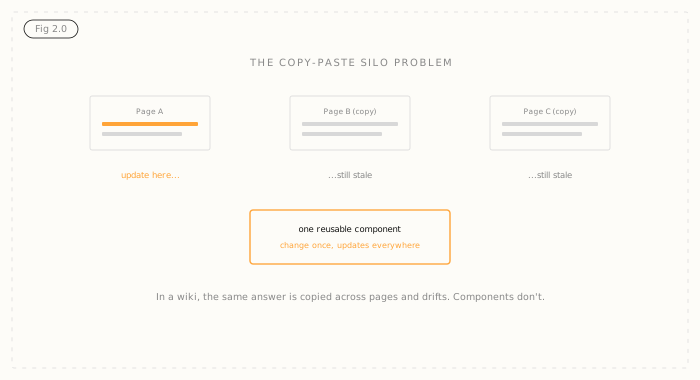
Confluence organises content as pages. Product documentation needs content as reusable components, and that mismatch is the root of most of the pain. A page is a silo: to use the same warning or procedure in three places you copy it, and copies drift out of sync. There's no true single source.
The failure modes, concretely
Five show up again and again:
- No content reuse: shared content is copy-pasted across pages, so one change leaves the other copies stale.
- No multi-channel output: getting clean, branded PDF or structured help out of a wiki is a constant fight.
- No translation workflow: nothing tracks what changed, so you re-translate whole pages instead of only new content.
- No structured metadata: pages carry little machine-readable structure, which limits filtering, reuse, and retrieval.
- No AI-ready output: feeding a wiki to an LLM or RAG pipeline inherits every duplicate and stale page.
When it's time to move, and to what
The signal isn't a single missing feature - it's the pattern: copy-paste everywhere, translation costs climbing, no confident single version, and an AI project stalling on wiki content. When product documentation becomes a scaling and compliance problem, a Component Content Management System is the category built for it. Keep Confluence for the wiki; move product docs to a system designed for reuse and governance.
Where Author-it fits
Author-it manages product documentation as reusable components in a single source: change a component once and every document using it updates, translate only what changed, publish the same source to PDF, HTML, help, and more, and govern it all with version control and a built-in audit trail. And it produces AION, a structured JSON output built for LLMs and RAG pipelines, so the same governed content is ready for AI, something a wiki can't offer.
This isn't Confluence versus Author-it - they do different jobs. It's about not asking a wiki to be a documentation system. See how it works for software teams, or benchmark your content with the Structured Content Challenge.

Confluence Docs FAQ
Q: Can you use Confluence for technical documentation?
A: Yes, and for internal wikis and collaborative knowledge it works well. It struggles when you need structured product documentation at scale - content reuse, multi-channel publishing, translation workflow, controlled versions, and AI-ready output. Confluence organises content as pages, and product docs need reusable components, which is the root of the mismatch.
Q: What are Confluence's limitations for product documentation?
A: The main ones are no true content reuse (shared content is copy-pasted and drifts), no clean multi-channel publishing, no translation workflow that tracks changes, limited structured metadata, and no AI-ready structured output. Individually manageable; together they make Confluence expensive to maintain as product documentation scales.
Q: When should you move from Confluence to a CCMS?
A: When the pattern sets in: copy-paste duplication everywhere, climbing translation costs, no confident single version of key content, and AI projects stalling on wiki content. That's the signal product documentation has outgrown a wiki and needs a system built for reuse, governance, and multi-channel output.
Q: Does Confluence support content reuse and single-sourcing?
A: Not in the way structured documentation needs. Content lives as pages, so reusing the same procedure across documents usually means copying it, and copies drift. A Component Content Management System stores content once as a component and reuses it by reference, so a single change propagates everywhere it's used.
Q: Can Confluence content feed AI reliably?
A: Only as reliably as the content itself, which in a wiki is often duplicated, unversioned, and lightly structured. An LLM or RAG pipeline inherits those problems and returns inconsistent answers. A structured, governed output like AION gives AI clean, current, single-source content instead.
Q: What replaces Confluence for structured documentation?
A: A Component Content Management System. It manages product documentation as reusable components with single-sourcing, translation, version control, multi-channel publishing, and AI-ready output. Many teams keep Confluence for internal wikis and move product documentation to the CCMS, using each tool for the job it's good at.
Published on:
Author:
June 30, 2026
Jamie Simmonds
Documentation Manager
Related Resources

Article
Content lock-in: the exit tax nobody budgets for
The cost of leaving a content platform rarely makes the business case - until you try to switch. Here is the exit tax, and how open output removes it.
Article
Docs-as-code vs CCMS: the limits at scale
Markdown is prose with formatting. Structured content carries what reuse and reliable AI retrieval need.

Guide
FrameMaker migration to a modern CCMS
Migration anxiety keeps FrameMaker teams put. A phased, supported move drops the risk sharply.