Article
Three metadata layers your AI gets free with Author-it

TL;DR: AI systems are only as good as the content they are grounded in - and content is only as trustworthy as its metadata. Author-it builds three distinct metadata layers into every content object: intrinsic (auto-generated from system state), designed (inherited from structural decisions at authoring time), and deliberate (applied by authors and taxonomists). The key distinction from competitors is that this metadata is authored in from the start, not retroactively enriched. AION R1 begins to expose this infrastructure to AI systems - with more metadata fields being added in future releases based on customer feedback.
This is the architecture behind the AI content foundation. See what AION exports.
Why metadata matters more than the words
Most conversations about AI and content focus on the words - the quality of the writing, the completeness of the topics, the clarity of the instructions. These matter. But they are not what makes content trustworthy to an AI system.
What makes content trustworthy to an AI system is metadata: the structured information about the content that tells a model what it is looking at, where it came from, when it was last updated, and who wrote it. Without metadata, an LLM has no way to distinguish between a current topic and an obsolete one, between a Procedure and a Warning, between content that applies to one product line and content that applies to another.
Metadata is not decoration. It is the signal layer that makes structured content retrievable, typed, and useful to AI systems. And it is where most organisations discover, too late, that their content infrastructure was not built for this purpose.
Author-it builds metadata in three distinct layers. Understanding the difference matters - because each layer does a different job for the AI systems consuming your content.
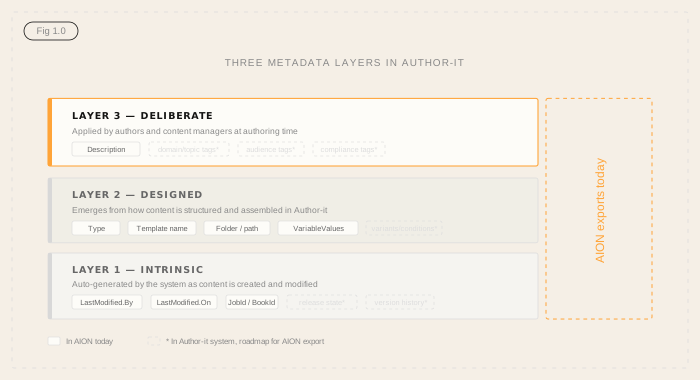
Layer 1 - Intrinsic metadata: what the system records automatically
Intrinsic metadata is the baseline - what Author-it creates and maintains automatically as a function of operating a governed content system. Authors do not choose it. The system generates it, updates it, and preserves it as part of every content object's record.
It includes:
- Provenance - when this content object was created, by whom, and from what source
- Modification history - every change, with timestamp and author identity
- Library folder path - the organisational location of the content within the Author-it library
- Publication history - when it was published, to which outputs, in which job
For an AI system, intrinsic metadata answers basic trust signals: who last touched this content, when, and from where in the content hierarchy does it come. Most content systems - wikis, shared drives, unstructured knowledge bases - have none of this. Author-it generates it as a side effect of normal operation, and AION R1 exports it as part of every content object.
Layer 2 - Designed metadata: what structure decides
Designed metadata emerges from the structural decisions made when content is architected in Author-it. It is not manually applied to individual topics - it cascades from the content architecture itself.
When a content architect defines an information architecture in Author-it, they make decisions that implicitly create metadata at scale:
- Content type - is this a task, a concept, a reference, a warning, a specification? Author-it's template system encodes this. The template name travels in every AION content object, giving AI systems a typed signal about how to use the content - not just what it says.
- Applicability conditions - which products, versions, regions, or audiences does this content apply to? Author-it's variant and conditional publishing logic captures this. This is on the roadmap for AION export.
- Structural relationships - which topics are children of which parents? Which components are shared across which books? AION exports the full content hierarchy as nested objects.
- Variable bindings - which product names, version strings, and configurable values are resolved from the variable library? AION exports these as VariableValues, already resolved at publish time.
This is the layer most competitors cannot replicate by adding a semantic enrichment layer on top. Designed metadata is not a tag applied after the fact - it is an emergent property of authoring in a structured system. You cannot recover it from a flat document. It has to be built in from the start.
Layer 3 - Deliberate metadata: what authors and taxonomists apply
Deliberate metadata is the most visible layer - the tags, classifications, and annotations that authors and taxonomy managers consciously apply to content objects. It includes:
- Domain and topic classification - which subject area does this content belong to?
- Audience tags - who is this content for?
- Compliance tags - does this content relate to a specific regulatory standard or safety classification?
- Product and version scoping - which specific product or configuration does this content describe?
Deliberate metadata is where the human expertise of your content team compounds into AI capability. Author-it supports this through its classification and object properties system. Not all deliberate metadata is currently exported via AION - this is an area where the output format will expand as the roadmap develops.
Why three layers beat one layer bolted on
Every major content and knowledge management vendor is now marketing some form of semantic enrichment. The pitch is roughly the same: take your existing content, run it through an AI enrichment pipeline, and emerge with metadata-rich content ready for RAG. It is a reasonable product idea. It is also a compromise.
Retroactively enriching content has three fundamental problems:
- The intrinsic layer cannot be recovered. Modification history and authorship records are system-generated artefacts. If your content was not in a governed system when it was created, that record does not exist. You cannot AI-generate a trustworthy modification trail.
- The designed layer is architecture, not text. Structural relationships, variable bindings, and content type are encoded in the architecture of the content system. They cannot be reliably inferred from the text of a flat document.
- The deliberate layer is only as good as the taxonomy it references. Without a controlled vocabulary and a maintained taxonomy, AI-generated tags are inconsistent, unstable over time, and not governed by domain experts.
Author-it's three-layer approach is not a post-processing pipeline. It is the result of building content in a governed structured authoring system from day one. The metadata advantage compounds over time, because every new piece of content inherits the same structure automatically.
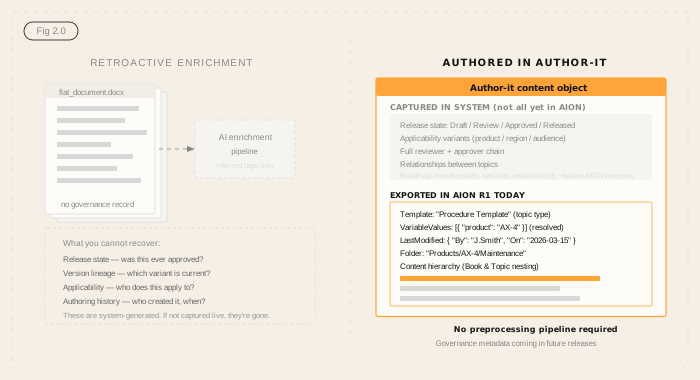
What AION exports today - and where it's heading
When you publish content from Author-it via AION, the current R1 output gives AI systems:
- Content hierarchy - the full nested Book to Topic structure, preserved as JSON
- Resolved variables - product names, version strings, and configurable values already substituted at publish time, eliminating ambiguity in the text
- Topic type - the template name for every topic, telling the AI system whether it is reading a Procedure, a Warning, a Concept, or a Specification
- Modification history - who last modified each content object and when, as first-class fields
- Folder structure - the library path that provides organisational context
- Clean Markdown text - with no page headers, footers, table fragments, or layout artefacts from PDF conversion
Release state (approved/draft/archived), applicability conditions (variant information), and relationship graphs are captured in the Author-it system and are on the roadmap for AION export in future releases. Hyperlinks are confirmed for AION in 2026.R3. The rest will be driven by customer feedback from the upcoming focus group.
A note on what Author-it does not claim (yet)
Author-it does not claim that AION R1 solves every AI content problem out of the box. It is a strong foundation: structured, typed, variable-resolved content with modification history and clean Markdown. That is already substantially better than feeding an LLM PDFs or unstructured wiki exports.
The governance layer - release state, applicability conditions, full relationship graphs - exists in the Author-it system. Exposing it fully in AION is a progression, not a starting point. Building a reliable enterprise AI system on top of Author-it content still requires a retrieval architecture, an LLM integration layer, and ongoing governance of taxonomy and classification.
What Author-it does provide is the content foundation that makes those systems worth building. If your content does not have the three layers described here as its authoring foundation, retrofitting them is harder than starting right.
That foundation is what AION exposes to your AI stack. Explore AION, or book a demo to see the metadata layers in your own content.

AI Metadata FAQ
Q: What is metadata in the context of AI content?
A: Metadata is structured information about a piece of content - not the words themselves, but the data that describes what those words are, where they came from, who approved them, and in what context they apply. For AI systems, metadata is the governance layer that enables accurate retrieval, prevents hallucination, and makes AI outputs auditable. Without metadata, an LLM cannot reliably distinguish between approved current content and outdated or inapplicable content.
Q: What are the three metadata layers in Author-it?
A: Author-it builds three metadata layers into every content object. Intrinsic metadata is auto-generated by the system - provenance, version history, governance state, and audit trail. Designed metadata emerges from structural authoring decisions - content type, applicability conditions, conditional publishing logic, and structural relationships. Deliberate metadata is applied by authors and taxonomists - domain classification, audience tags, compliance classifications, and product scoping.
Q: Can metadata be added to content after it has been created?
A: Deliberate metadata - tags, classifications, audience labels - can be applied retrospectively to existing content. But intrinsic metadata (governance history, approval records, version lineage) cannot be recovered for content that was not created in a governed system. Structural designed metadata (applicability conditions, variable bindings, content type) also cannot be reliably inferred from flat documents after the fact. This is why retrofitting unstructured content for AI use is fundamentally limited.
Q: What is AION and how does it carry metadata?
A: AION is Author-it's structured JSON publishing format, released in 2026.R1. When content is published via AION, all three metadata layers travel with it as first-class fields in the output object. The receiving system - whether a RAG pipeline, a vector database, or an LLM integration layer - can use these fields as filters, confidence signals, and retrieval constraints without any additional preprocessing.
Q: How does metadata reduce AI hallucinations?
A: Hallucinations in enterprise AI systems most commonly occur when incorrect content is retrieved and passed to the model as context. Metadata reduces this risk in two ways. First, applicability conditions and product scoping allow the retrieval system to filter out content that does not apply to the current query context. Second, governance state fields allow the system to filter out draft, archived, or superseded content. The fewer irrelevant chunks passed to the model, the lower the hallucination risk.
Q: Does Author-it support custom metadata fields?
A: Yes. Beyond the three standard layers described here, Author-it supports custom metadata fields that organisations can define to match their specific taxonomy, compliance framework, or content governance requirements. These custom fields are included in AION output alongside the standard metadata, making them available to downstream AI systems without additional engineering.
Published on:
Author:
May 13, 2026
Osmar Silva
CTO
Related Resources

Article
The CCMS reckoning: six priorities for the AI era
A response to the industry's CCMS reckoning: the six priorities content leaders now face, and an honest look at which are shipped versus roadmap.
Article
AI-ready content: who has actually shipped it?
A practical field guide to separating AI-ready content marketing from vendors who have actually shipped a structured, governed output for AI.
Webinar
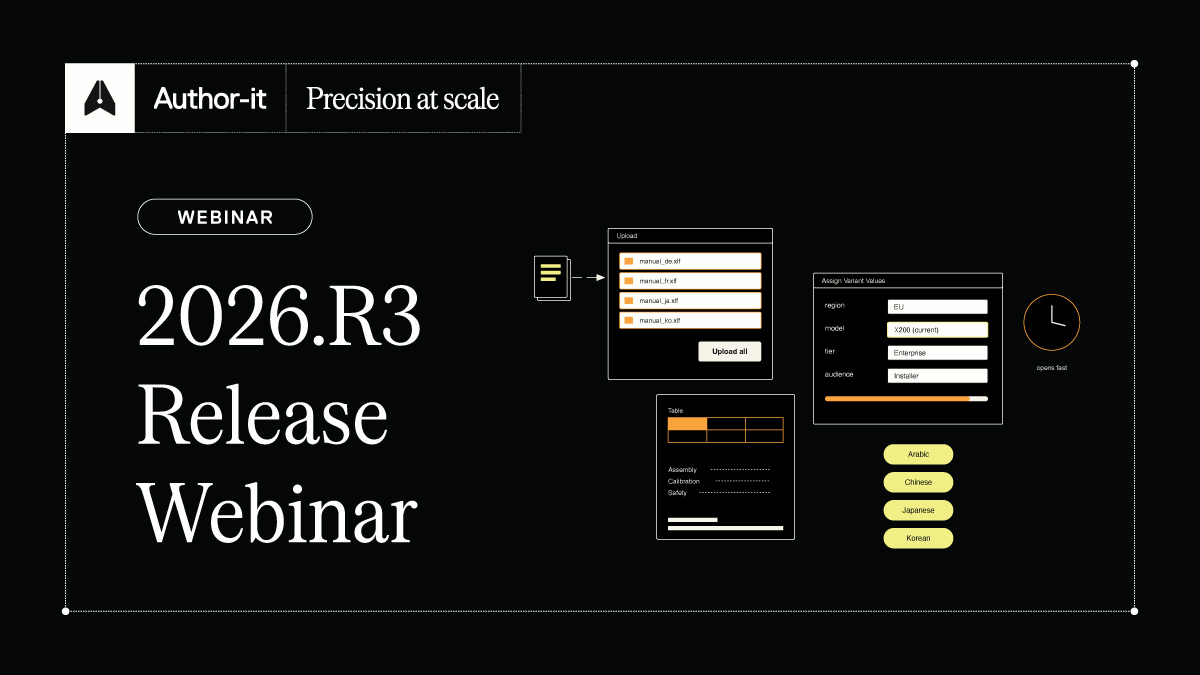
Author-it 2026.R3 Release Webinar - What's New
The full Author-it 2026.R3 release webinar recording, with the biggest New Word update yet, richer AION output, and the R3 go-live dates.