Article
Policy management software: a buyer's guide for 2026

Summary:
Most organisations buy policy management software hoping it will fix their compliance content problem. It won't - because the tool is only as good as the content inside it. Policies that are duplicated, unstructured, and version-fragmented will break just as spectacularly inside a governance platform as they did in SharePoint. The fix is a structured content foundation: single-source authoring, component reuse, and AI-ready output that makes policy content findable, accurate, and machine-readable - before it ever touches a workflow tool.
📊 Organisations with structured policy content report 40–60% fewer compliance incidents linked to outdated documentation
💡 AION, Author-it's structured JSON output, makes policy content directly consumable by AI systems and enterprise search - without a rebuild
The policy management software promise - and the gap nobody talks about
Every compliance team has been here: an audit finds a gap, leadership demands a fix, and someone buys policy management software. A new platform lands. Workflows get configured. Access controls get set. And then the content gets migrated.
That's when the problems start.
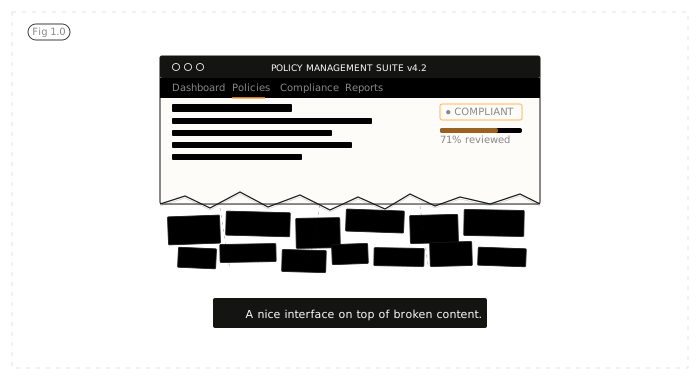
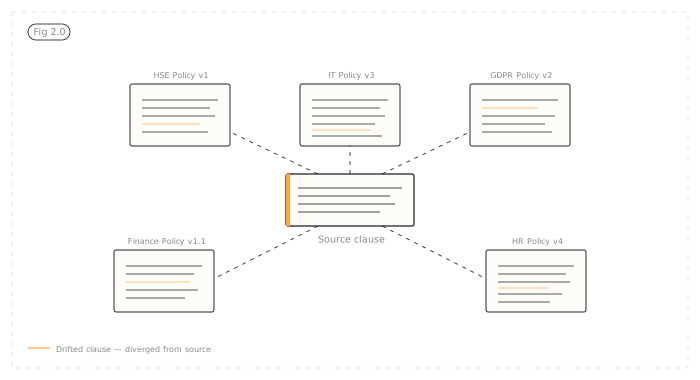
Because the policies themselves - the actual written documents - are a mess. The same clause exists in six places with six different versions. The product name changed two years ago but only got updated in some documents. The safety procedure references a regulatory standard that was superseded eighteen months ago. None of that gets fixed by a new workflow tool. It just gets a nicer interface.
Policy management software solves the workflow layer of your compliance problem. It does not solve the content layer. And in most organisations, the content layer is where the actual risk lives.
What "policy management" actually means - and what it doesn't
Policy management platforms - the likes of PowerDMS, Ideagen, LogicGate, or a custom SharePoint deployment - are fundamentally workflow tools. They handle:
- Document storage and version control
- Approval routing and sign-off tracking
- Attestation workflows ("I have read and understood this policy")
- Audit trails and compliance reporting
- Review cycle scheduling
These are valuable capabilities. But notice what's missing: none of them address how the policy content is structured, authored, or maintained. They assume the content is already correct and coherent. It rarely is.
The result is that organisations spend significant budget on policy governance infrastructure - and then discover that the content inside it is still creating risk.
The real compliance content problem
Ask any compliance manager what actually keeps them up at night and it's rarely the approval workflow. It's things like:
- A product change that should have updated fourteen policies - but only updated three, because there was no single source of truth for that content
- A regulatory update that required amending the same clause in forty documents - done by hand, inconsistently
- An auditor asking for the current version of a procedure and getting four different answers depending on who they asked
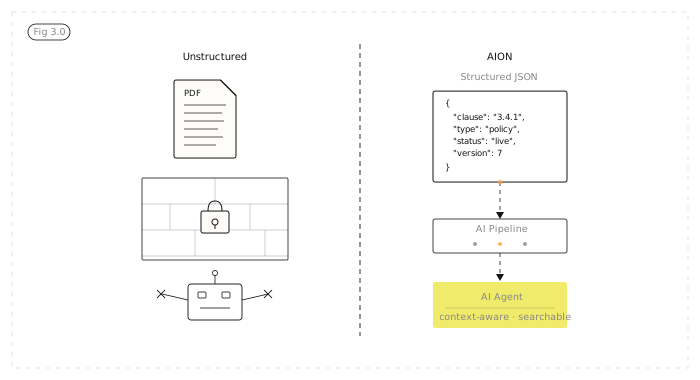
- Policy content that exists but can't be surfaced by enterprise search or AI tools because it's locked in unstructured Word documents and PDFs
These are content architecture problems. And the only way to solve them is to fix how the content is created and maintained - not just how it's approved and stored.
What structured policy content actually looks like
Structured content means breaking policy documentation into reusable components - sections, clauses, definitions, procedures - that live in a single source and can be assembled into multiple documents without copying and pasting.
In Author-it, those components are called Topics. A Topic might be a safety clause, a data handling procedure, a regulatory reference, or a product definition. Each Topic is authored once, stored centrally, and reused across every policy document that needs it.
When that clause changes - because a regulation updated, or a product name changed, or legal revised the language - you update it once. Every document that uses it is updated automatically. No manual find-and-replace. No version drift. No audit risk.
This is the principle behind component content management (CCMS), and it's been the foundation of reliable documentation in manufacturing, software, and regulated utilities for decades. It applies just as directly to policy management as it does to technical manuals or safety documentation.
Learn more about structured authoring and how it works in Author-it.
The AI layer: why policy content needs to be machine-readable
There's a second problem emerging that most policy management software buyers aren't thinking about yet: AI readability.
Enterprise AI tools - internal chatbots, contract review systems, compliance Q&A assistants - are increasingly expected to surface policy content accurately and in real time. Ask the system: "What is our current data retention policy for EU customer records?" It should give you the right answer from the current version of the right document.
That only works if the underlying content is structured, versioned, and published in a format that AI systems can actually ingest. A PDF in a SharePoint folder is not that. A Word document with track changes is definitely not that.
Author-it's AION output format publishes policy content as structured JSON - mirroring the full content hierarchy: books, sub-books, topics, metadata, and resolved variables. This is what makes content directly consumable by LLMs and RAG pipelines without a custom rebuild every time a policy changes.
The organisations investing in AI-assisted compliance now aren't just buying better workflow tools. They're fixing their content architecture so that AI systems can actually do something useful with it.
See how AION makes structured content AI-ready.
The policy management software evaluation checklist you're probably missing
When evaluating policy management software, most RFP processes ask about workflow features, integration capability, and audit reporting. Few ask about the content architecture the system is built on.
Here's what should be on your list:
- Single-source authoring: Can a change to a shared clause automatically propagate to every document that uses it?
- Component reuse: Are policies assembled from reusable building blocks, or are they standalone documents?
- Structured output: Can the content be published in machine-readable formats (HTML, JSON, XML) as well as PDFs?
- Translation readiness: If policies need to be maintained in multiple languages, does the system support single-source translation workflows?
- Version control at the component level: Can you see the full history of a single clause, not just a whole document?
Most policy management software scores zero on this list. That's not a criticism — it's a scope definition. These tools are built for governance, not authoring. The structured content layer needs to come from a CCMS that integrates with or feeds into the policy platform.
How regulated industries are solving this
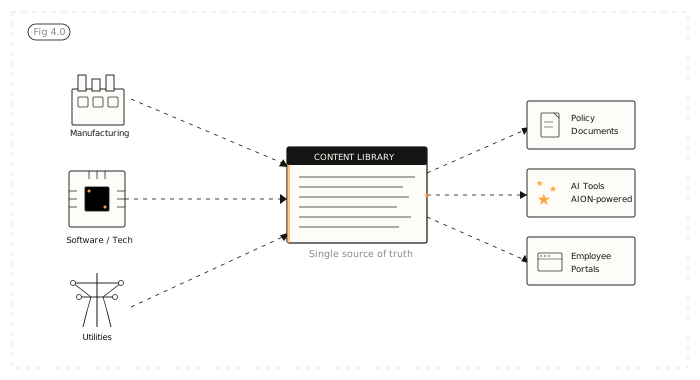
Manufacturing companies managing safety documentation and regulatory compliance procedures have been solving this problem for years using structured authoring. A single product change triggers a targeted update to the relevant components — which flows through to every affected document, in every language, for every market. The policy management platform then handles the approval and distribution workflow on top of content that is already accurate.
Software companies with complex product documentation and compliance requirements (SOC 2, ISO 27001, data governance frameworks) are increasingly applying the same approach to their policy libraries — because the manual alternative doesn't scale.
Utilities managing operational procedures across multiple sites and regulatory regimes find that structured content is the only practical way to maintain accuracy at scale - and increasingly, to make that content available to field workers through AI-assisted tools.
The pattern is the same across verticals: the workflow tool handles governance. The CCMS handles content accuracy. And a structured, AI-ready output layer connects both to the AI tools that are becoming part of every compliance team's toolkit.
Internal link: See how Author-it serves manufacturing documentation and compliance workflows.
Where to start if your policy content is a mess
The good news: you don't need to rebuild everything at once. The practical starting point is identifying the content that creates the most risk - the policies with the most regulatory exposure, the most frequent updates, the widest distribution - and applying structured authoring principles there first.
Author-it has been implementing structured content programmes in regulated industries for over 25 years. The transition from document-based to component-based policy content is well-understood, and the ROI shows up quickly: faster update cycles, fewer errors, lower translation costs, and content that's ready for AI tools rather than a liability in them.
If you're evaluating policy management software, the most valuable question you can ask is: "What are we doing about the content layer?" The workflow can wait. The content foundation can't.

Policy Management FAQ
Q: What is policy management software?
A: Policy management software is a category of governance tools that handle the storage, approval, distribution, and audit trail for organisational policies and procedures. They manage workflows - who needs to review, approve, and attest to each policy - but do not typically address how the policy content itself is authored or structured.
Q: Why doesn't policy management software solve content accuracy problems?
A: Policy management platforms are workflow tools. They assume the content inside them is already correct, current, and consistently maintained. If the underlying documents are duplicated, unstructured, or version-fragmented - as they often are after years of manual editing - the platform provides governance over content that is still inaccurate. A CCMS addresses the content layer that policy platforms don't.
Q: What is a CCMS and how does it relate to policy management?
A: A Component Content Management System (CCMS) is a platform for authoring and managing content as reusable components rather than standalone documents. In the context of policy management, a CCMS means that shared clauses, procedures, and definitions are authored once and reused across multiple policies. When something changes, it updates everywhere automatically - eliminating the version drift that creates compliance risk.
Q: What does AI-ready policy content mean?
A: AI-ready policy content is structured and published in machine-readable formats - typically structured JSON or XML - that AI systems (internal chatbots, RAG pipelines, compliance assistants) can ingest directly. Content locked in PDFs or Word documents cannot be reliably consumed by AI tools without expensive custom extraction. Author-it's AION format publishes content as structured JSON that mirrors the full content hierarchy, making it directly consumable by LLMs without a rebuild.
Q: Can Author-it integrate with existing policy management software?
A: Author-it functions as the content authoring and management layer that sits upstream of policy workflow tools. Content authored and maintained in Author-it can be published in multiple output formats - including HTML, PDF, and AION structured JSON - which can feed into policy management platforms, enterprise portals, and AI systems. The structured content layer and the governance workflow layer are complementary, not competing.
Q: What industries use structured authoring for policy management?
A: Structured authoring for policy and compliance documentation is most mature in manufacturing (safety documentation, regulatory procedures), software/technology (compliance frameworks, security policies, product documentation), and utilities (operational procedures, regulatory compliance). These industries manage high volumes of compliance-critical content that changes frequently and must be maintained across multiple products, sites, and jurisdictions - exactly the conditions where a CCMS delivers the most value.
Q: How long does it take to migrate from document-based to structured policy content?
A: The timeline depends on the volume and complexity of existing content, but most Author-it implementations in regulated industries see initial structured content workflows live within 3–6 months, with full migration of legacy content completed over 12–18 months. The highest-risk, highest-update-frequency content is typically prioritised first - delivering compliance risk reduction quickly while the broader library is migrated systematically.
Published on:
Author:
April 21, 2026
Ben Harris
Marketing Lead
Related Resources

Article
Field crew AI: when a wrong answer is a safety risk
Why safety-critical field operations can't run AI on ungoverned content - and what deterministic, traceable answers actually require.

Article
AI service assistants for manufacturing field techs
What it takes to put an AI service assistant in a manufacturing field tech's hands without risking a wrong, outdated, or unsafe answer.
Article
AI-ready content: who has actually shipped it?
A practical field guide to separating AI-ready content marketing from vendors who have actually shipped a structured, governed output for AI.