Article
Software and financial services outgrowing Word

Why it matters:
Software and financial services firms using Word for technical documentation are absorbing hidden costs in version management, compliance risk, and content rework that a structured system eliminates.
Summary:
Microsoft Word is a word processor, not a content management system. Software companies and financial services firms that build documentation practices on Word accumulate hidden costs in manual version management, duplicated content, compliance exposure, and slow release cycles. A structured content platform replaces this with a single source of truth that scales without adding headcount - and that serves as a reliable foundation for AI systems.
Why Word persists in technical documentation
Nobody wakes up and decides Word is the right documentation infrastructure for an enterprise software company or a regulated financial services firm. It happens by default. Word is already there. Writers know it. Getting a document written today is faster than spending a week evaluating alternatives.
Then the documentation library grows. The same product description appears in a user guide, a compliance submission, a help article, and a sales enablement doc. Policies that need to stay current sit across dozens of files maintained by different people. Release notes are copied and edited from previous versions and distributed by email. The first compliance audit surfaces gaps. And at some point, someone has to ask: how do we know what version of this procedure was in place on that date?
By then, the Word habit has compounded into a debt that's genuinely difficult to quantify - and even more difficult to make visible to leadership who authorise the budget for proper documentation infrastructure.
The five ways Word creates compounding documentation debt
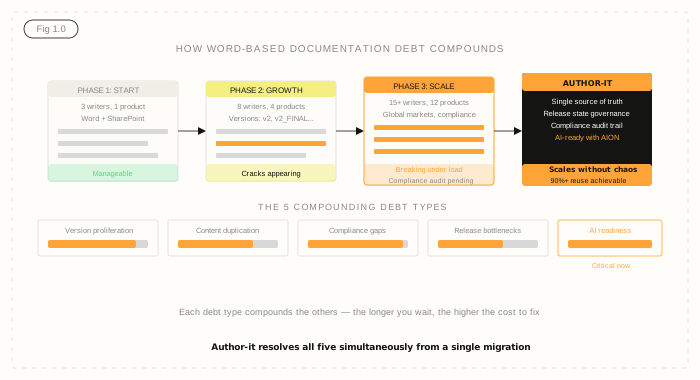
Software and financial services teams accumulate documentation problems in predictable patterns. These are the five most common, in rough order of when they become acute.
Version proliferation is first. A document gets shared by email, downloaded, edited locally, re-uploaded to SharePoint, and eventually no one is certain which version is authoritative. Teams develop naming conventions - v2, v2_FINAL, v2_FINAL_revised - that signal process failure, not process discipline.
Content duplication comes second. The same policy clause appears in a terms of service, a compliance manual, an onboarding guide, and a staff handbook. When the policy changes, four documents need updating. Someone usually misses at least one. The incorrect version stays live somewhere in the organisation.
Compliance traceability is the third - and most dangerous - gap. Regulators asking for evidence of what was in place on a specific date get back a folder of Word files, a version history that may or may not be complete, and an email chain that constitutes the approval workflow. This is not what a sophisticated regulator wants to see.
Release velocity is fourth. Software companies tying documentation to product releases find that Word-based processes slow everything down. Writers are updating multiple files in parallel. Review cycles happen by tracked changes in email attachments. Publishing means exporting to PDF and distributing manually. The documentation function becomes a bottleneck.
AI readiness is the fifth - and newest. Word documents are notoriously difficult to parse reliably for AI systems. The layout structure, the formatting artefacts, the lack of semantic metadata, the absence of any indication of approval state or content freshness - these make Word-sourced content a poor foundation for RAG pipelines, LLM grounding, or internal AI tools.
What software companies specifically need from documentation
Software documentation sits at the intersection of product releases, customer support, compliance, and increasingly AI infrastructure. What a software company actually needs from its documentation system is quite specific.
It needs to decouple documentation from the release cycle - so that writers can prepare content ahead of release, release-gated publishing means content goes live when the feature ships, and teams don't scramble at the last minute.
It needs reuse across help centre, in-product tooltips, API reference, and internal knowledge base. The same explanation of a feature shouldn't be written four times and maintained separately.
It needs accessibility compliance output by default - not as a manual QA step. 508 and WCAG compliance is required for government and regulated sector customers. It needs to come out of the publishing process, not be retrofitted.
And increasingly it needs its documentation to serve as a reliable source for AI tools - internal search, support chatbots, AI-powered help centres. That requires structured, governed content with metadata that AI systems can use.
What financial services specifically needs from documentation
Financial services documentation operates under a different pressure than software: the regulatory requirement for accuracy, traceability, and version control is not optional. It's a compliance obligation with direct financial consequences for failure.
MiFID II, GDPR, SOX, and sector-specific regulatory frameworks all require that organisations can demonstrate what policies and procedures were in place at a point in time, who approved them, and that staff operated under current versions. A Word-based documentation environment cannot reliably demonstrate this. It can produce documents, but the governance around those documents depends entirely on human discipline rather than system enforcement.
Author-it's release state model changes this at the architectural level. Content transitions through defined states - draft, in review, approved, released - with access controls at each stage. Unapproved content cannot reach published output. Every approval is logged with a timestamp and user identity. An auditor's question about what was in place on a given date is answered by the system, not reconstructed from email threads.
How Author-it fits software and financial services
Author-it is used by a global software leader managing over 90% content reuse across its documentation library - achieving $2M+ in annual savings through structured reuse and machine translation efficiency. The same principles apply whether you're managing API documentation, policy documentation, or regulatory filings.
The core mechanism is the same. Content is authored once as structured components. Variables handle product-specific or version-specific values. Conditional content handles audience-specific or channel-specific variations. Output templates produce the required format - PDF, HTML5, Word, web help - from the same source. Release states govern what reaches output. The audit trail is automatic.
For software teams, this means documentation that ships with the product, not after it. For financial services teams, this means compliance documentation that can demonstrate its own governance without requiring a manual audit exercise.
Word's hidden costs show up in version management and compliance risk. Author-it vs Microsoft Word sets out the difference feature by feature.
The AI content foundation angle
Both software and financial services are piloting AI tools that depend on high-quality content as their foundation. Internal knowledge bases, customer support chatbots, compliance query tools, product documentation search - all of these need reliable, current, structured content to function accurately.
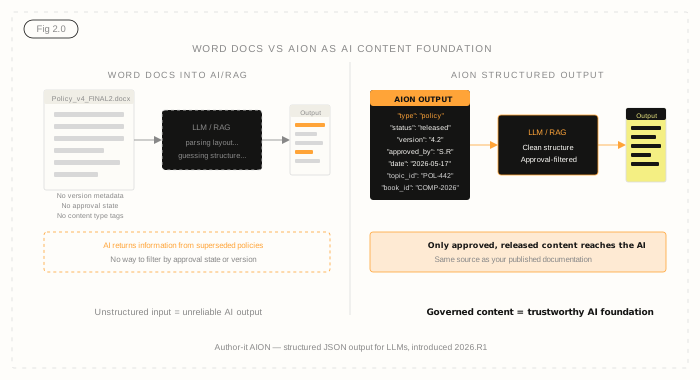
Word documents fed into an LLM or RAG pipeline produce unreliable results. The content structure is ambiguous. There's no metadata indicating which version is current. There's no approval state to filter by. The AI confidently returns information from superseded policies or outdated product descriptions.
Author-it's AION output - introduced in 2026.R1 - provides exactly what AI systems need. Structured JSON with source metadata, content type, version provenance, and governed approval state. The documentation that serves your help centre also serves your AI tools. The governance you apply to publication carries through to the AI layer. Only approved content reaches the AI. Unapproved drafts don't.
For companies in this position, Author-it isn't just a documentation upgrade. It's the content foundation their AI strategy depends on.

Word-Based Documentation FAQ
Q: Why do software and financial services companies end up with Word as their primary documentation tool?
A: Word is preinstalled, familiar, and adequate for small-scale documentation. Most teams start there because getting started is frictionless. The problems accumulate over time - as headcount grows, as content volume increases, as the same information appears in more and more documents that need to stay in sync, and as compliance requirements around documentation become more formal.
Q: How does Author-it differ from a SharePoint or Confluence documentation approach?
A: SharePoint and Confluence manage files and pages, not structured content components. They improve discoverability and access control over local drives, but they don't solve the underlying problem: the same information is still written and maintained in multiple places. Author-it stores content at component level - a policy, a procedure, a product description - and publishes it to any required output. Change the component once and it updates everywhere.
Q: Can Author-it integrate with the tools software teams already use - JIRA, GitHub, Confluence?
A: Author-it's API and integration architecture supports connection to external systems. For software documentation teams, this means content workflows can connect to existing dev tooling. The specifics depend on the integration required - Author-it's team can scope the right approach for a given environment.
Q: How does structured content help with financial services regulatory documentation?
A: Financial services firms face specific regulatory documentation requirements - MiFID II, GDPR, SOX, and others - that require evidence of version control, approval workflows, and content accuracy at a point in time. Author-it's release state model and audit trail are built for exactly this requirement. Content cannot be published without approval. Every version is logged. The system produces the evidence regulators require without manual reconstruction.
Q: What happens to our existing Word documents?
A: Existing Word content can be migrated into Author-it as structured components. The migration is a project - the content is reviewed, structured, and imported. Historical documents are archived. Going forward, all new content is authored in Author-it. The migration is typically phased, starting with the most actively maintained documentation.
Q: Does Author-it support the accessibility compliance requirements that software companies face?
A: Yes. Author-it's output templates include 508/WCAG accessibility compliance by default. This is a significant advantage for software companies selling into government or regulated sectors - it removes the manual accessibility checking step from the documentation workflow and ensures every published output meets the required standard.
Q: How does AION help software companies using internal AI tools?
A: AION is Author-it's structured JSON publishing format. It outputs governed content in a form that AI systems - internal search, LLMs, RAG pipelines, chatbots - can reliably consume. For a software company, this means the same documentation that powers your help centre also becomes the foundation for your AI support tools. The governance embedded in Author-it carries through - only approved, released content reaches the AI layer.
Published on:
Author:
May 29, 2026
Ben Harris
Marketing Lead
Related Resources

Article
Content lock-in: the exit tax nobody budgets for
The cost of leaving a content platform rarely makes the business case - until you try to switch. Here is the exit tax, and how open output removes it.
Article
Docs-as-code vs CCMS: the limits at scale
Markdown is prose with formatting. Structured content carries what reuse and reliable AI retrieval need.

Guide
FrameMaker migration to a modern CCMS
Migration anxiety keeps FrameMaker teams put. A phased, supported move drops the risk sharply.