Article
ISO compliance across global manufacturing: a playbook

Why it matters:
Global manufacturers are managing ISO compliance across dozens of sites and languages. Unstructured documentation makes that nearly impossible to sustain.
Summary:
ISO 9001 compliance at a single site is manageable. ISO 9001 compliance across five sites, four languages, and twelve product lines is a fundamentally different challenge. Most documentation approaches that work at scale within one geography begin to fail when they have to cross borders, translate, and satisfy auditors who may be checking a site that headquarters hasn't visited in two years.
This is the structured content playbook - five steps that turn global documentation from a coordination problem into a system.
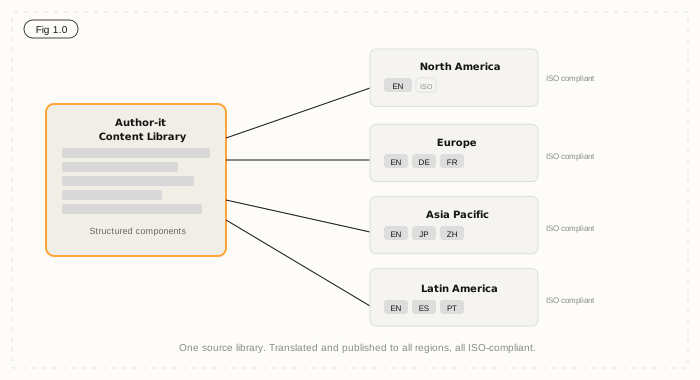
Step 1: Centralise the source
The foundation of global ISO compliance is a single authoritative content library. Not a shared drive. Not a document register pointing to files stored across multiple servers. A single system where every piece of approved content lives in one place and every output - every PDF, every HTML page, every translated document - comes from that single source.
In Author-it, this is the Library. Every component - a procedure step, a safety warning, a specification value, a regulatory reference - is stored once and referenced by every document that needs it. When something changes, it changes in one place. Every document that references that component reflects the update automatically after it passes through the approval workflow.
For global operations, this means regional sites don't maintain their own document repositories. They access the approved published versions from the central library. There's no synchronisation problem because there's nothing to synchronise - there's only one source.
Step 2: Structure the content
Centralising unstructured content - PDFs, Word documents, scanned procedures - doesn't solve the problem. It consolidates the problem. To get the benefits of single-source publishing, content needs to be structured: written in components, tagged with metadata, and organised so the system knows what type of content it is, who it applies to, and which outputs it belongs in.
Structured content enables two things that global ISO compliance requires. First, conditional publishing - the ability to include or exclude content based on defined criteria (product line, region, regulatory regime) without maintaining separate documents. A manufacturing procedure can include region-specific regulatory references for EU sites and different references for Asia-Pacific sites, from the same source document. Second, translation memory - structured components can be translated once and reused across documents, rather than requiring every document to be translated from scratch when content is shared.
The investment in structuring legacy content pays back quickly at global scale. Content that exists once and is translated once is dramatically less expensive to maintain than content that exists in multiple documents and requires multiple translation updates every time the underlying specification changes.
Step 3: Govern the workflow
At global scale, governance is the hardest part to get right. Multiple sites, multiple authors, multiple subject-matter experts, multiple languages - and one quality management system that needs to be consistent across all of them. Without enforced workflow, this is where compliance breaks down.
Author-it's approval workflow is configurable at the document and component level. For content that applies globally - a shared safety standard, a core quality procedure - the approval path runs through the appropriate global authority. For content that applies only to specific regions - a local regulatory compliance note, a country-specific work instruction - approval can route through the appropriate regional authority. The governance structure mirrors the organisation's authority structure, not a one-size-fits-all approval chain.
The publishing gate enforces compliance with the governance structure. Content at any stage of the workflow that hasn't been approved by the required approvers cannot be published. The ISO requirement to control documented information and prevent use of unapproved content is satisfied architecturally, not by process discipline that someone might forget to follow.
Step 4: Localise without losing control
Translation and localisation are where most global documentation approaches start to fragment. A document goes out to a translation vendor. It comes back as a new file. It gets stored somewhere that makes sense at the time. A year later, the source document is updated, the translation is not, and no one knows whether the translated version at the site in Germany is current.
Author-it's translation workflow treats translated content as components in the library, not as separate files that happen to exist in another language. When a source component is updated and approved, the translation is flagged as requiring review. The translated version cannot be published in its updated state until the translation has been reviewed and the new version approved. The same governance that applies to source content applies to translations.
This means regional sites get current, compliant documentation in their language - and headquarters has confidence that what's being used at every site is the approved version, not an outdated translation that no one noticed had fallen behind. See how manufacturers managing global translation workflows have reduced translation costs through structured content reuse.
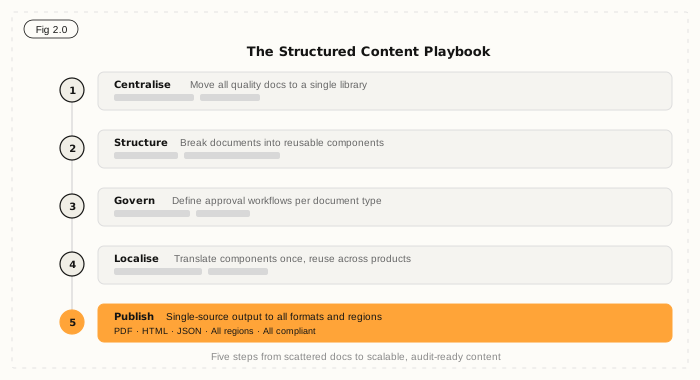
Step 5: Publish to every format from one source
Global ISO compliance requires documentation in multiple formats. Shop floor procedures as PDFs. Quality management system documentation for auditors accessible on-screen. Training materials in a format the learning management system can consume. And increasingly, documentation in structured formats that enterprise AI systems can use for quality assurance, safety screening, and compliance checking.
Author-it's publishing engine produces all of these from the same approved source content. PDF for print. HTML for portals. AION - Author-it's structured JSON output format launched in 2026.R1 - for LLMs and RAG pipelines. A change to a procedure flows through approval once and publishes to every required format simultaneously.
For global operations, this means an engineering change that requires documentation updates triggers one approval event that produces compliant documentation in all required formats and languages, distributed to all sites. The alternative - manually updating documents, then updating the translations, then converting to PDFs, then pushing to regional sites - takes weeks and introduces the distribution errors that cause ISO non-conformances.
What the playbook looks like in practice
The five steps are sequential and dependent. Centralisation without structure creates a central dump. Structure without governance creates well-organised unapproved content. Governance without localisation means the framework only works in one language. And localisation without multi-format publishing means compliant content still doesn't reach the right people in the right format.
Organisations that have implemented all five steps report two consistent outcomes: audit readiness that doesn't require a pre-audit sprint, and the ability to add new sites, product lines, or language requirements without proportionally increasing the documentation overhead.
The Structured Content Challenge is a useful starting point for identifying where in these five steps your current approach is working and where it's creating risk. The ROI calculator translates the gaps into a financial case for closing them.

Global manufacturing ISO compliance FAQ
Q: How do global manufacturers maintain ISO 9001 compliance across multiple sites?
A: Global manufacturers maintain ISO 9001 compliance across multiple sites through a combination of centralised content governance and controlled distribution. The critical elements are: a single authoritative content library that all sites draw from rather than maintaining local repositories, enforced approval workflows that apply consistently across all content regardless of origin, a publishing gate that prevents unapproved or outdated content from reaching any site, and a structured translation process that keeps local-language versions synchronised with source content updates. Without these elements, each site tends to develop its own documentation practices, making consistent compliance impossible to verify from the centre.
Q: What is structured content and why does it matter for ISO compliance?
A: Structured content is content broken into discrete, tagged components - procedure steps, specifications, warnings, regulatory references - rather than unbroken documents. Each component has defined metadata (type, applicability, approval status, version) and is stored in a central library. For ISO compliance, structured content matters because: changes to shared content propagate automatically to every document that uses it; approval happens at the component level, so a single approval event updates all dependent documents; and publishing gates apply consistently regardless of which document a component appears in. Unstructured document management requires individual tracking of each document's currency - structured content makes currency a system property.
Q: How does translation management work in a CCMS for ISO-certified manufacturers?
A: In a CCMS, translations are treated as versions of source components rather than separate files. When a source component is updated and approved, the system flags dependent translations for review. The translated version cannot be published until it has been reviewed against the updated source and approved. This means translated documentation stays in sync with source documentation through the same governance system - the translation gap that causes non-conformances at regional sites is closed by architecture rather than by hoping someone notices the source changed.
Q: How many sites can be managed under one ISO 9001 certification?
A: ISO 9001 certification scope is defined during the certification process and can cover any number of sites, provided the quality management system operates consistently across all of them. There's no technical limit in the standard. The practical limit is the organisation's ability to maintain consistent documentation, controls, and evidence of compliance across all sites - which is a documentation system challenge, not a certification rule. Organisations using structured content management with single-source publishing can scale certification scope significantly without proportional increases in documentation effort.
Q: What does ISO 9001 require for documentation in different languages?
A: ISO 9001 doesn't mandate specific language requirements - the standard requires that documented information be available and suitable for use where it's needed. In practice, this means that if your quality management system operates at a site where the working language is German, your controlled procedures and work instructions need to be accessible and understandable in German. Auditors at that site will check that documentation is current and usable at point of use. A translation that has fallen behind a source update may still be technically available, but if the auditor can identify that it doesn't reflect a recent engineering change, it's a potential finding.
Q: How does AION support ISO compliance in global manufacturing?
A: AION is Author-it's structured JSON output format, launched in 2026.R1, that makes approved content available to LLMs and RAG pipelines. For global manufacturers, AION means that the same approved, governed content that produces PDFs and HTML documentation can also power enterprise AI systems for quality assurance, safety screening, training support, and compliance checking. Because the AION output comes through the same publishing gate as all other formats, AI systems only ever access approved content - the same ISO compliance guarantee that applies to printed procedures applies to AI-accessible content.
Q: What is the typical implementation timeline for a CCMS across a global manufacturing organisation?
A: Implementation timelines depend on scope, content volume, and existing documentation infrastructure. For global organisations with complex legacy content across multiple sites and languages, Author-it implementations typically run 90 to 180 days from kickoff to full operational deployment. Phased approaches - starting with a pilot site or product line before expanding - are common and often preferable, as they let the team develop structured content practices before scaling. Author-it's implementation team has experience migrating content from Word, SharePoint, FrameMaker, and legacy document management systems across global rollouts.
Published on:
Author:
April 22, 2026
Osmar Silva
CTO
Related Resources
Article
Field crew AI: when a wrong answer is a safety risk
Why safety-critical field operations can't run AI on ungoverned content - and what deterministic, traceable answers actually require.
Article
AI-ready content: who has actually shipped it?
A practical field guide to separating AI-ready content marketing from vendors who have actually shipped a structured, governed output for AI.
Article
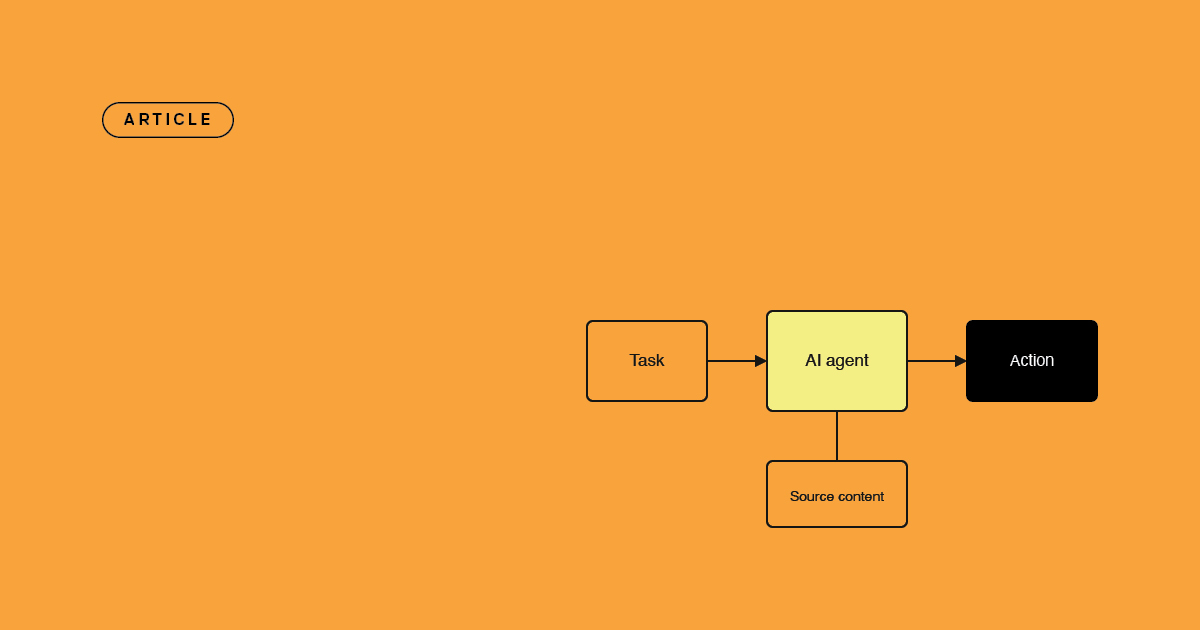
Agentic AI for documentation: a practical guide
How AI agents use documentation to take action - and why agentic AI raises the bar on structured, governed content.