Article
ISO audit readiness across multiple manufacturing plants

Summary:
ISO audit readiness is harder than getting certified in the first place. When you're managing multiple plants and product lines, the same document control standards need to work consistently at every site - and a gap at any one location is a gap in your certification. This article covers the specific documentation challenges multi-site manufacturers face, what auditors look for across sites, and what a centralised, structured approach looks like in practice.
What audit-ready actually means for multi-site manufacturers
For a single-site operation, audit readiness is a documentation problem. For a manufacturer with three plants in three countries, it's a coordination problem on top of a documentation problem.
ISO 9001 doesn't have a lower standard for remote sites or smaller facilities. Every location covered by your quality management system has to meet the same requirements. The auditor visiting your Singapore plant isn't grading on a curve relative to Munich or Chicago.
This means audit readiness isn't achieved once and maintained centrally - it has to be a continuous state at every site simultaneously. Most manufacturers find this harder than the original certification.
The document consistency problem across plants
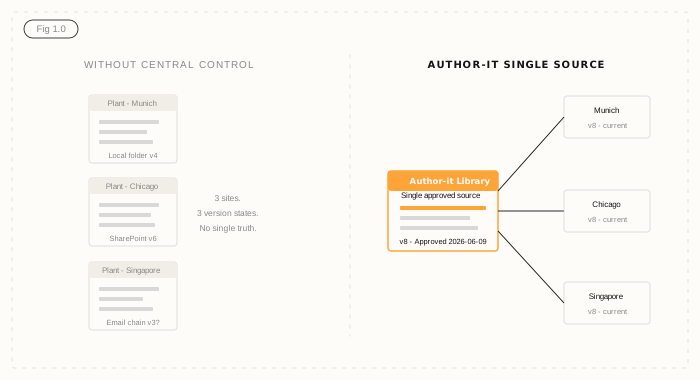
The most common multi-site documentation failure isn't that sites lack documents. It's that the same document exists in different states at different locations.
Plant A updated a work instruction in March. Plant B has the February version - the team lead knew about the update but hadn't distributed it yet. Plant C has a localised version that diverged six months ago when a local engineer adapted it for regional equipment. Three sites, three versions, one ISO certification that covers all three.
When an auditor asks to see the current version of that work instruction at Plant C, the local version they produce may or may not match what headquarters considers current. If it doesn't, that's a non-conformance. If the auditor asks for the approval trail and it was done by email in a different time zone, that's another problem.
How product line sprawl multiplies the problem
Multi-site documentation challenges scale with product line complexity. A manufacturer with eight product lines across five plants isn't managing one document control problem - they're managing forty simultaneous version states, each of which needs to be current at every applicable site.
The mathematics of manual document management break down quickly. A change to a shared specification affects every product line that references it. Tracking which sites use which documents, confirming they've received updates, and verifying that obsolete versions have been removed is a full-time coordination effort before you've written a single word of new content.
Component-based content management changes this arithmetic. A shared specification becomes a single component referenced by every document that needs it. Update it once, and every document, at every site, reflects the change automatically. The version number increments once. The approval trail is one record, not forty.
This is the structured authoring approach at the core of Author-it's manufacturing solution - and it's why organisations with high content reuse see their documentation overhead drop significantly.
The real cost of audit preparation that shouldn't exist
Talk to any quality manager at a multi-site manufacturer and they'll describe a recognisable ritual: two to four weeks before a surveillance audit, someone starts pulling together the documentation, chasing down approvals for things that should have been approved months ago, and hoping no auditor asks about Plant C's older printer that has been running from a shared folder no one quite owns.
That ritual is a symptom of a system that only achieves compliance on demand. The documentation isn't wrong, exactly - it's just not continuous. The effort required to present an audit-ready picture in November shouldn't be different from what the picture looks like in April.
Use the Structured Content Challenge to see how your current setup scores against continuous compliance criteria - the results often clarify exactly where the gap sits.
What a centralised, structured approach looks like
The manufacturers that maintain consistent ISO audit readiness across multiple sites share a common architecture: a single source of content that all sites access, rather than copies of content distributed to sites.
The difference matters. Copies drift. A single source doesn't. When an engineer in Munich approves a revision to a work instruction, that revision is immediately available to Chicago and Singapore without a distribution email, a SharePoint sync, or anyone having to remember to update a local folder.
In Author-it, the Library is that single source. A content component approved in the Review and Approve workflow is publishable to every format and every location from that one approval event. The audit trail is tied to the component, not the distribution. There's one record of who approved what, when - not one per site.
Making audit readiness a continuous state
The goal isn't to pass your next audit. It's to reach a state where the next audit requires no preparation because the documentation is always current, always approved, and always consistent across every site.
That state requires three things: a single source of truth that all sites access, a workflow that makes approval the gating event before any content reaches the field, and a publishing mechanism that distributes automatically rather than requiring manual coordination.
Author-it's publishing gate governance ensures that unapproved content cannot reach any output - PDF, HTML, or AI-ready JSON via AION. The control is architectural, not procedural. It doesn't depend on someone remembering to check before they distribute. Explore the ROI calculator to understand what your current multi-site coordination overhead is actually costing.

Multi-site ISO audit FAQ
Q: Does ISO 9001 require the same documentation standards at every manufacturing site?
A: Yes. If a site is within the scope of your ISO 9001 certification, it is subject to the full requirements of the standard - including Clause 7.5 document control. Auditors conduct site visits and surveillance audits at covered locations. A non-conformance at one site affects the overall certification status, not just that location's standing.
Q: How do multi-site manufacturers ensure all locations have the current document version?
A: The most reliable approach is a single-source architecture where all sites access content from one central system rather than receiving copies. With copies, distribution can fail silently - someone forgets to update a folder, an email goes unread, a local version gets modified. With a single source, there is no distribution step to fail. All sites see the same content from the same approved source.
Q: What is the biggest documentation risk in multi-site ISO audits?
A: Version inconsistency is the most common finding. Auditors check that the version of a document in use at a site matches the approved current version in the quality management system. When sites maintain their own local copies - in shared drives, SharePoint, or printed binders - those copies routinely drift from the central version. The gap is often invisible until an auditor asks for it.
Q: How often should documents be reviewed in a multi-site ISO environment?
A: ISO 9001 requires that documented information be reviewed and updated as necessary - it doesn't specify a fixed review cycle. In practice, multi-site manufacturers typically define minimum review intervals (annually is common) with trigger-based reviews whenever a process, product, or regulatory requirement changes. The challenge is making sure the review cycle is actually tracked and that updates reach all sites simultaneously.
Q: Can a CCMS help manufacturers manage ISO documentation across multiple plants?
A: Yes. A Component Content Management System (CCMS) provides a single source of truth for all documentation. When a component is updated and approved, every document that references it - across every product line and every site - is automatically updated. There's no manual distribution, no risk of sites running different versions, and no separate approval process per site. The audit trail is centralised and searchable from one place.
Q: What documents are typically checked during a multi-site ISO surveillance audit?
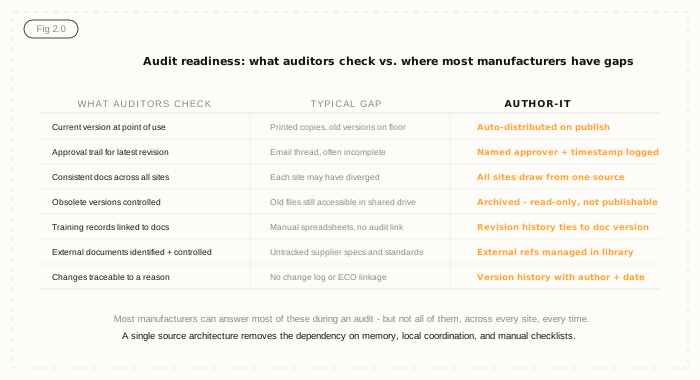
A: Auditors typically check work instructions and SOPs at point of use, the approval history for recent document revisions, training records linked to current document versions, records of change management and corrective actions, and evidence that obsolete documents are controlled and cannot be used operationally. In a multi-site audit, they compare findings across locations to identify inconsistency.
Q: How does Author-it support ISO audit readiness across multiple manufacturing sites?
A: Author-it's Library is a single content source that all sites access. The Review and Approve workflow ensures every document change is approved by named reviewers before reaching any output. Publishing gate governance makes it architecturally impossible for unapproved content to be published - not just procedurally discouraged. The complete approval history is searchable from one place, making audit responses immediate rather than a search exercise.
Published on:
Author:
June 1, 2026
Adrian Winks
CEO
Related Resources

Article
Field crew AI: when a wrong answer is a safety risk
Why safety-critical field operations can't run AI on ungoverned content - and what deterministic, traceable answers actually require.

Article
AI service assistants for manufacturing field techs
What it takes to put an AI service assistant in a manufacturing field tech's hands without risking a wrong, outdated, or unsafe answer.
Article
AI-ready content: who has actually shipped it?
A practical field guide to separating AI-ready content marketing from vendors who have actually shipped a structured, governed output for AI.