Article
ISO 9001 document control: where certifications are won

Summary:
ISO 9001's document control requirements - governed under Clause 7.5 - are where most manufacturers either win or lose their certification. The standard requires that documented information be available, current, and protected at all times, but in practice many manufacturers are managing this through shared drives, email chains, and manually updated spreadsheets. This article breaks down what ISO 9001 actually demands from your document control process and what a structured approach looks like in practice.
What ISO 9001 Clause 7.5 actually says
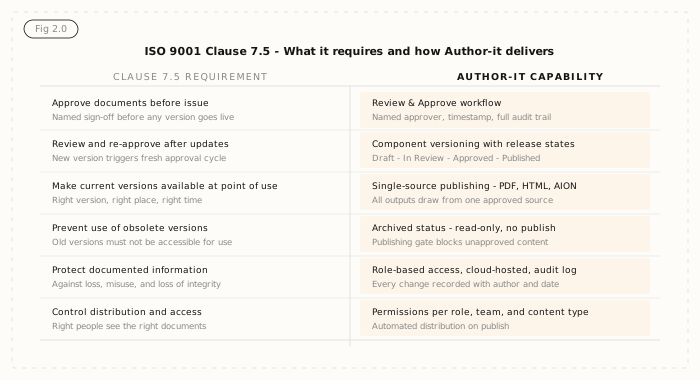
Clause 7.5 of ISO 9001:2015 replaced the old documents-and-records framework with a unified concept called documented information. It governs everything from your quality manual and SOPs to work instructions, inspection forms, and training records.
The standard requires you to approve documented information before issue, review and re-approve it after updates, make current versions available at the point of use, prevent unintended use of obsolete versions, maintain adequate protection against loss and misuse, and control access so the right people can find the right content.
None of this is unreasonable. The problem is that in a real manufacturing environment - with multiple product lines, multiple shifts, and constant engineering change orders - meeting all six consistently is harder than it sounds.
Where do ISO 9001 document control audits typically fail?
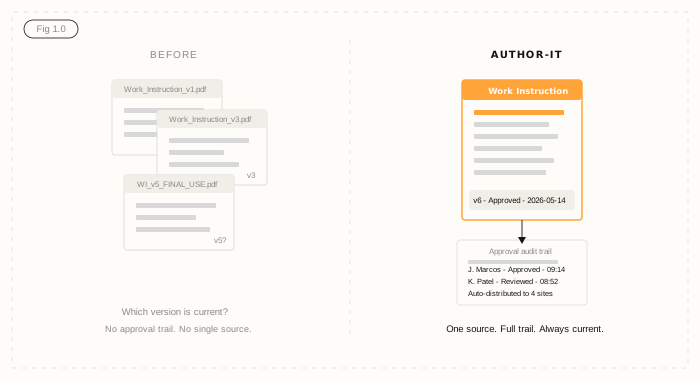
The most common ISO 9001 document control failure isn't deliberate negligence - it's operational drift. A work instruction gets updated by engineering. The updated version is saved to the shared drive and emailed to the shift supervisors. Three weeks later, an auditor asks a line operator to locate the current version. They open a printed copy pinned to the workstation - version 3. The current version is version 5.
No one did anything wrong on purpose. The process just wasn't designed to prevent this. And that gap is exactly what a surveillance audit is designed to find.
Document control failures that commonly trigger ISO non-conformances include multiple versions of the same document in circulation, no clear approval trail for recent changes, controlled documents that are difficult to locate quickly under audit conditions, and external documents - supplier specifications, regulatory standards - that haven't been re-reviewed since they were first added.
The approval trail problem
ISO 9001 requires that changes to documented information are reviewed and re-approved. For many manufacturers, this happens via email - a draft goes out, a few people reply with approved, and the document gets updated manually.
That works until an auditor asks you to prove it. At that point you're searching through old email threads hoping the right approvals are findable. If the person who originally approved a procedure has left the company, the trail gets even murkier.
What auditors want to see isn't just the current version of a document - they want evidence of a controlled process: who approved this, when, and what changed from the previous version. A structured content system with built-in approval workflows creates that trail automatically. Author-it's Review and Approve module records every review action with a timestamp and named approver - so the audit trail exists without anyone having to reconstruct it after the fact.
Version control is harder with documents than with software
Software teams have version control built into their tools. Manufacturing teams have shared drives, version numbers in filenames, and hope. It's not a fair fight.
Managing version control manually across dozens of product lines means someone has to track which version is current, which locations have been notified, and which printed copies need replacing. That's a coordination problem, not a content problem. And coordination problems compound with scale.
Component-based content management changes this. Instead of managing whole documents, you manage individual content components - a warning, a specification, a procedure step. When an engineering change affects a component that appears in twelve different documents, you update it once and every document that references it reflects the change automatically. The version increment happens at the component level, and the full document gets a new version number automatically. See how manufacturers are using this approach at Author-it's manufacturing page.
Point-of-use availability: the last-mile problem
Clause 7.5 requires that documented information be available where and when it is needed. For a manufacturing line, that means operators can locate the current version of a work instruction - not a printed copy from six months ago - before they start a task.
This is the last-mile problem. Central storage is usually fine. Getting the current version reliably to the production floor, to field service engineers, and to contractors working at remote sites is where most manual systems fail.
Single-source publishing - where every output draws from the same approved source - solves this at the architecture level. There's one source of truth. When it changes, all outputs reflect the change. There's no distribution step that can go wrong because distribution is automatic.
What good looks like in practice
ISO 9001 doesn't specify the technology you need. It specifies the outcomes. The organisations that consistently pass audits with minimal findings tend to share a few characteristics: every document has a clear owner, changes go through a defined approval process with a complete trail, current versions are findable in under two minutes by anyone who needs them, obsolete versions are inaccessible for operational use, and the whole system doesn't depend on any one person's institutional knowledge to function.
If your current setup depends on someone knowing where things are kept, you have a succession risk - and an audit risk. Use the Structured Content Challenge to benchmark where your documentation process stands.
The audit isn't the problem - it's the detector
A lot of manufacturers treat ISO document control as an audit-preparation exercise - something you tighten up in the weeks before a surveillance visit. That's exactly backwards. The audit doesn't create document control problems; it reveals them. The non-conformances an auditor finds in November were probably present in April.
Continuous compliance means your document control process is robust enough that an audit tomorrow would produce the same result as an audit in six months. That requires a system, not a schedule. Author-it is a Component Content Management System built for manufacturing organisations that need to meet those standards consistently. If you want to understand what a structured content approach would look like for your operation, the ROI calculator can help you estimate the cost of your current documentation overhead.

ISO document control FAQ
Q: What is ISO 9001 Clause 7.5 and why does it matter for manufacturers?
A: ISO 9001 Clause 7.5 covers documented information - the standard's requirements for how organisations create, update, protect, and control documents and records. For manufacturers, this means every quality document, work instruction, and production record must be approved, versioned, accessible to the right people, and protected from unintended use of outdated versions. It's one of the most audited clauses because poor document control is one of the most common sources of non-conformance.
Q: What documents need to be controlled under ISO 9001?
A: ISO 9001 requires control of all documented information that supports your quality management system - including SOPs, work instructions, quality policies, inspection records, training records, and any external documents like supplier specifications or regulatory standards that affect your processes. If a document influences the quality of your product or service, it needs to be controlled.
Q: How does ISO 9001 define an approved document?
A: ISO 9001 requires that documented information be reviewed and approved for adequacy before it is issued or updated. Approved means a defined person or role has signed off on the content - not just the document creator. The approval must be traceable, meaning you can demonstrate who approved a document and when. A structured content system with built-in approval workflows creates this trail automatically.
Q: What is the difference between a document and a record under ISO 9001?
A: ISO 9001:2015 merged these two concepts into documented information but the practical distinction still matters. Documents like SOPs and work instructions are actively managed and updated - they need version control and approval workflows. Records like inspection results and training logs capture what happened at a point in time - they need retention, protection from alteration, and retrievability. Both are subject to Clause 7.5 requirements.
Q: How long do ISO 9001 records need to be retained?
A: ISO 9001 doesn't specify a minimum retention period for most records - it requires organisations to define their own retention periods based on legal, regulatory, and business requirements. What the standard does require is that records remain retrievable and legible for whatever period you've committed to. For most manufacturing organisations this means cross-referencing industry regulations and customer contracts.
Q: Can a CCMS replace dedicated ISO document control software?
A: For many manufacturing organisations, yes. A Component Content Management System (CCMS) provides structured authoring, version control at the component level, built-in approval workflows with audit trails, role-based access, and multi-format publishing from a single source. These capabilities directly address the ISO 9001 Clause 7.5 requirements. The advantage of a CCMS over traditional document control tools is that it manages content at a more granular level, enabling reuse across products and markets without duplicating content.
Q: What happens if you fail an ISO 9001 document control audit?
A: Document control failures typically result in non-conformances classified as either major or minor. A major non-conformance - a systemic failure that casts doubt on the effectiveness of the quality management system - usually triggers a corrective action requirement and a follow-up audit within a defined period. Repeated or unresolved non-conformances can lead to suspension or withdrawal of certification, which affects customer contracts, regulatory approvals, and market access in industries where ISO certification is a prerequisite.
Published on:
Author:
June 11, 2026
Jamie Simmonds
Documentation Manager
Related Resources

Article
Field crew AI: when a wrong answer is a safety risk
Why safety-critical field operations can't run AI on ungoverned content - and what deterministic, traceable answers actually require.

Article
AI service assistants for manufacturing field techs
What it takes to put an AI service assistant in a manufacturing field tech's hands without risking a wrong, outdated, or unsafe answer.
Article
AI-ready content: who has actually shipped it?
A practical field guide to separating AI-ready content marketing from vendors who have actually shipped a structured, governed output for AI.