Article
What is deterministic AI for regulated industries

TL;DR: Probabilistic AI produces statistically likely answers - it is, by design, uncertain. For most applications this is acceptable. For regulated industries, where wrong answers carry audit risk, liability, and safety consequences, it is a fundamental problem. Deterministic AI - AI constrained by known rules and governed inputs - is what regulated industries actually need. Structured, typed, variable-resolved content is the prerequisite for it. Author-it builds the governance infrastructure that this requires. AION R1 begins to expose it, with release state and applicability conditions on the roadmap for future releases.
This is the case for the AI content foundation in regulated settings. See what AION exports today.
The difference that matters in regulated industries
When most people talk about AI, they mean systems that predict the most likely next token given a training distribution and a prompt. These systems are remarkable at many tasks. They are not reliable in contexts where the cost of being wrong is high and the definition of right is specific, governed, and legally meaningful.
A compliance officer asking an AI what the current procedure for equipment calibration under ISO 9001 is does not want a statistically likely answer. They want the approved, current, version-controlled procedure - the one signed off last quarter and that will hold up under audit. The difference between those two answers is not a matter of model quality. It is a matter of what the model has access to and how that access is governed.
This is the distinction between probabilistic and deterministic AI, and it is increasingly the central question for regulated industries evaluating AI deployment.
What probabilistic AI actually means
Probabilistic AI systems - which include all current large language models - generate outputs by sampling from a probability distribution over possible next tokens. Given a prompt, the model does not look up the answer. It generates the most likely response based on patterns learned during training, adjusted by the context provided in the prompt.
This architecture has well-documented consequences for enterprise use:
- The same prompt can produce different outputs at different times, or with different model versions.
- The model cannot cite which specific version of a document it used to generate its answer.
- The model can produce confident, fluent responses that are factually incorrect - hallucinations.
- The model cannot represent its own uncertainty accurately in all cases. A wrong answer often reads as confidently as a correct one.
None of these are bugs in any particular model. They are structural properties of probabilistic generation. For consumer applications - drafting emails, summarising articles, suggesting marketing copy - they are acceptable tradeoffs. For a regulated industry producing safety-critical documentation, executing compliance workflows, or advising on product specifications, they are disqualifying.
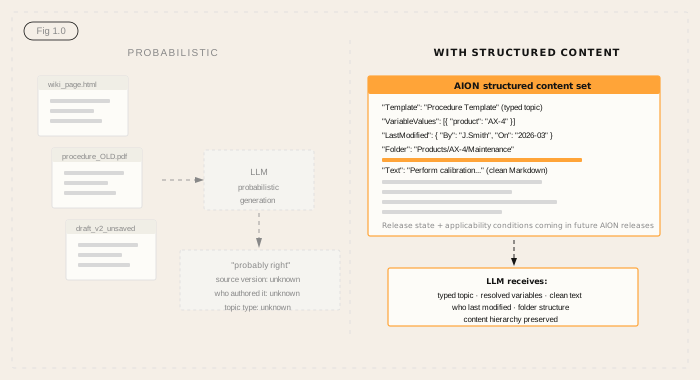
What deterministic AI means - and why it is harder
Deterministic AI is AI that produces consistent, auditable outputs from known, governed inputs - where the same query against the same approved content produces the same answer, and where that answer can be traced back to a specific approved source.
Pure determinism is a high bar. In practice, what regulated industries are pursuing is closer to what one framing describes as deterministic guardrails for probabilistic reasoning - systems where a language model generates responses, but where the inputs are constrained, the sources are governed, and the outputs can be verified against an authoritative record.
Achieving this requires three things to be true simultaneously:
- The content the AI reasons over must be the correct, current, typed content - not whatever happens to be in a shared drive or scraped from a wiki.
- The retrieval system must be able to filter by meaningful signals - returning only in-scope content for a given query.
- The output must be traceable - linked back to specific source content objects with modification history recorded.
The model itself is only one part of this equation. The content infrastructure is the other - and it is the part that most AI deployments in regulated industries have not solved.
The content problem at the heart of AI governance
Regulatory AI frameworks are converging on a common requirement: auditability. The EU AI Act, which enters full enforcement in August 2026, requires companies deploying high-risk AI systems in critical infrastructure, healthcare, and other regulated sectors to maintain audit trails demonstrating that AI outputs are traceable to governed inputs. Similar requirements are emerging in financial services, pharmaceutical, and industrial manufacturing contexts globally.
The practical challenge is that audit trail requirements cannot be satisfied by the AI model alone. The model can log what prompt it received. It cannot log the type, modification history, and source hierarchy of every content object it used to generate its response - unless that information was present in the content to begin with.
This is why the content foundation matters as much as the model. An AI system grounded in AION-published, Author-it-sourced content has access to:
- Topic type via template name - every content object carries whether it is a Procedure, Warning, Concept, or Specification, giving retrieval systems a typed signal
- Modification history - who last modified each object and when, as first-class fields in every AION output
- Resolved variables - product names, version strings, and configuration values already substituted at publish time, eliminating ambiguity
- Content hierarchy - the full Book to Topic structure, preserved as nested JSON, so the AI system understands context and position
- Folder structure - the library path that provides organisational and domain context
Release state (approved/draft/archived) and applicability conditions (variant information governing which product, region, or audience content applies to) exist in the Author-it system and are on the roadmap for AION export. When these fields are exposed, the traceability argument becomes significantly stronger. For now, typed content with modification history and resolved variables is already a substantially better foundation than unstructured PDFs or wiki exports.
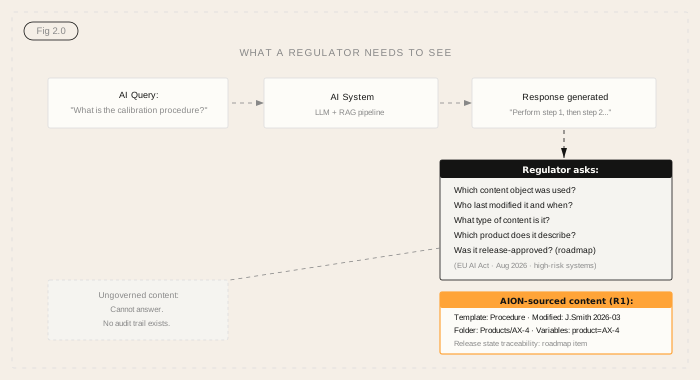
How structured content moves you closer to deterministic AI
No CCMS - including Author-it - will make a probabilistic language model fully deterministic. That is not what this argument claims. What structured, typed, governed content does is constrain the probability space in which the model operates.
When the retrieval layer works from AION-sourced content, the model has far less room to produce wrong answers. The haystack of possible sources has been replaced by a set of typed, structured objects with modification context. A retrieval system can already use template type to filter - returning only Procedures, not Warnings, for a how-to query. It can weight by LastModified.On to prefer recently updated content. It can use folder structure and resolved variable values as proximity signals.
In practice, this means:
- The model is less likely to confuse a Warning with a Procedure, because type information is explicit
- The model works from resolved, product-specific text rather than content with unresolved variable placeholders
- Every response can be linked back to specific source content objects with known modification history
When release state and applicability conditions join AION output on the roadmap, the filtering becomes more precise: only approved content retrieved, only in-scope content for the current product and region. That progression - from typed and structured today, to fully governed tomorrow - is what the AI content foundation argument is actually about.
What this means for your AI governance strategy
If your organisation is evaluating or deploying AI in a regulated context, the content audit should happen before the model evaluation. The questions to answer first are not which LLM to use - they are: Is our content structured and typed? Is it authored in a governed system with modification history? Can we trace any AI output back to a specific source object?
If the answer to any of these is no, the AI governance problem is primarily a content operations problem - not a model selection problem. Getting the content foundation right first is not a delay to your AI project. It is the work that makes your AI project defensible when a regulator asks hard questions.
Author-it and AION address the content side of this equation. The rest of the architecture - retrieval system, LLM, output layer - remains yours to select and configure. But without structured, typed content as the foundation, the rest of that architecture cannot deliver auditable AI.
Author-it and AION give that architecture a governed content foundation. Explore AION, or book a demo to see it on your regulated content.

Deterministic AI FAQ
Q: What is the difference between probabilistic and deterministic AI?
A: Probabilistic AI generates outputs by sampling from a probability distribution - it produces the most likely answer given its training and context, which means outputs can vary and cannot always be traced to a specific source. Deterministic AI produces consistent, auditable outputs from known, governed inputs - the same query against the same approved content produces the same traceable answer. In practice, most enterprise AI systems aim for deterministic guardrails around probabilistic models rather than pure determinism.
Q: Why do regulated industries need deterministic AI?
A: Regulated industries operate under frameworks - ISO standards, FDA regulations, EU AI Act requirements, sector-specific safety standards - that require auditability. An AI system that produces statistically likely answers cannot satisfy a regulator asking which approved version of a procedure the AI used to generate its output. Deterministic AI - or at minimum, AI with deterministic governance over its inputs - can answer that question with a traceable record.
Q: What is a content audit trail and why does AI need one?
A: A content audit trail is the record of who created a piece of content, who reviewed and approved it, when each action occurred, and what version is currently active. For AI systems in regulated industries, the audit trail enables the organisation to demonstrate which specific approved content sources were used to generate any given AI output. Without an audit trail in the content itself, this traceability cannot be achieved regardless of how sophisticated the AI model is.
Q: Can an LLM be made fully deterministic?
A: Not in the sense of always producing identical outputs - probabilistic generation is architecturally inherent in current LLMs. What can be achieved is substantial constraint of the probability space through governed content inputs, strict retrieval filtering, and version-locked source datasets. This produces AI behaviour that is consistent and auditable for practical regulatory purposes, even if not mathematically deterministic.
Q: How does AION help with deterministic AI for regulated industries?
A: AION is Author-it's structured JSON publishing format that exports content with its full governance metadata - version history, approval state, applicability conditions, and reviewer identity - as first-class fields. When this content is used in a RAG pipeline, the retrieval system can filter by governance state, ensuring only approved, current, applicable content is passed to the model. This means AI outputs can be traced back to specific governed content objects, supporting the auditability requirements of regulated industries.
Q: What content governance capabilities does Author-it provide?
A: Author-it provides a formal multi-stage Review and Approve module that tracks reviewer identity, approval decisions, and timestamps for every content object. It maintains complete version history, release state management, and compliance audit trails. It supports conditional publishing - so content applicability is encoded at authoring time, not inferred by an AI system at query time. All of this is included in the AION output format for downstream AI consumption.
Published on:
Author:
May 13, 2026
Adrian Winks
CEO
Related Resources
Article
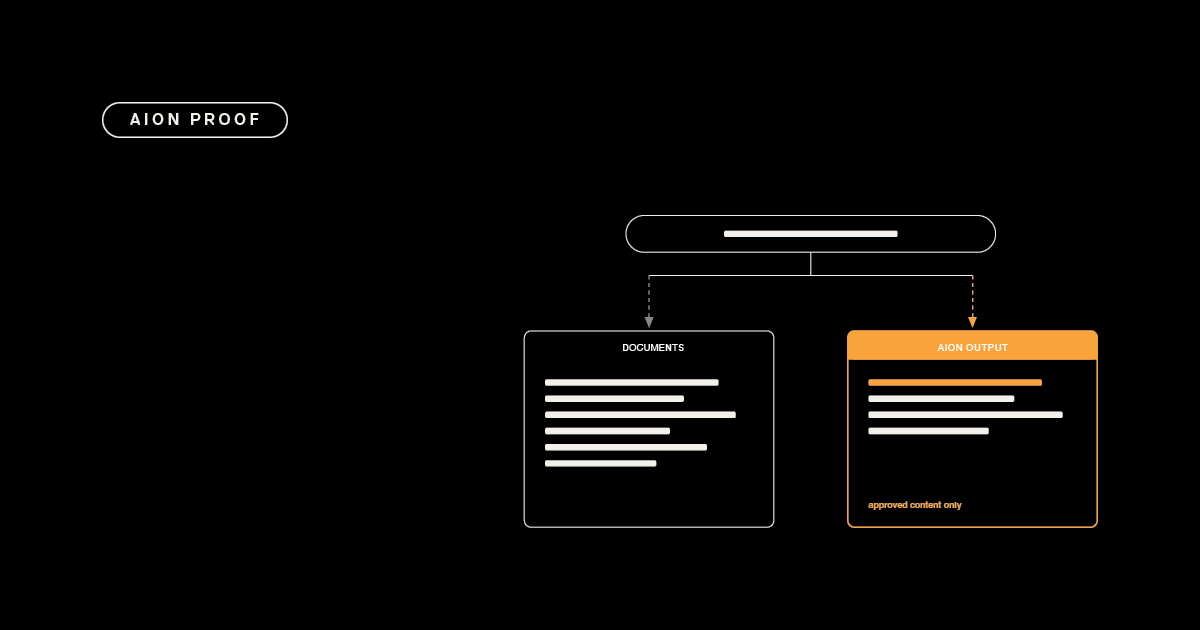
Author-it releases interactive AI grounding demonstration
Same question, two sources: why ungoverned documents give an AI three answers and governed content gives it one, with its source attached.

Article
Field crew AI: when a wrong answer is a safety risk
Why safety-critical field operations can't run AI on ungoverned content - and what deterministic, traceable answers actually require.
Article
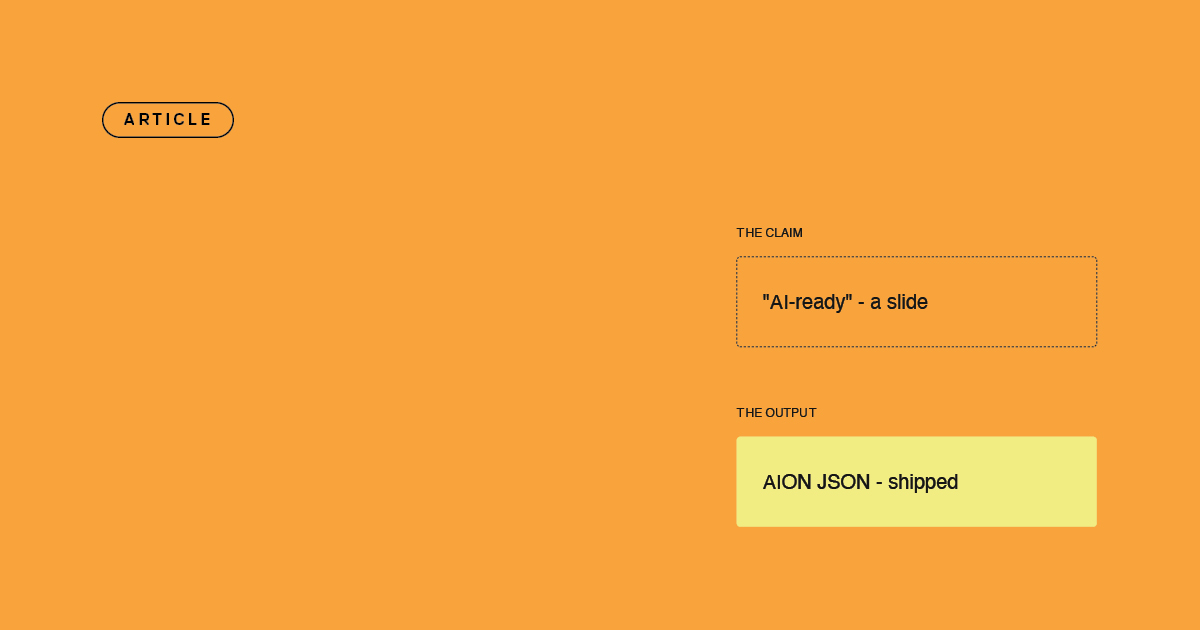
AI-ready content: who has actually shipped it?
A practical field guide to separating AI-ready content marketing from vendors who have actually shipped a structured, governed output for AI.